In this article
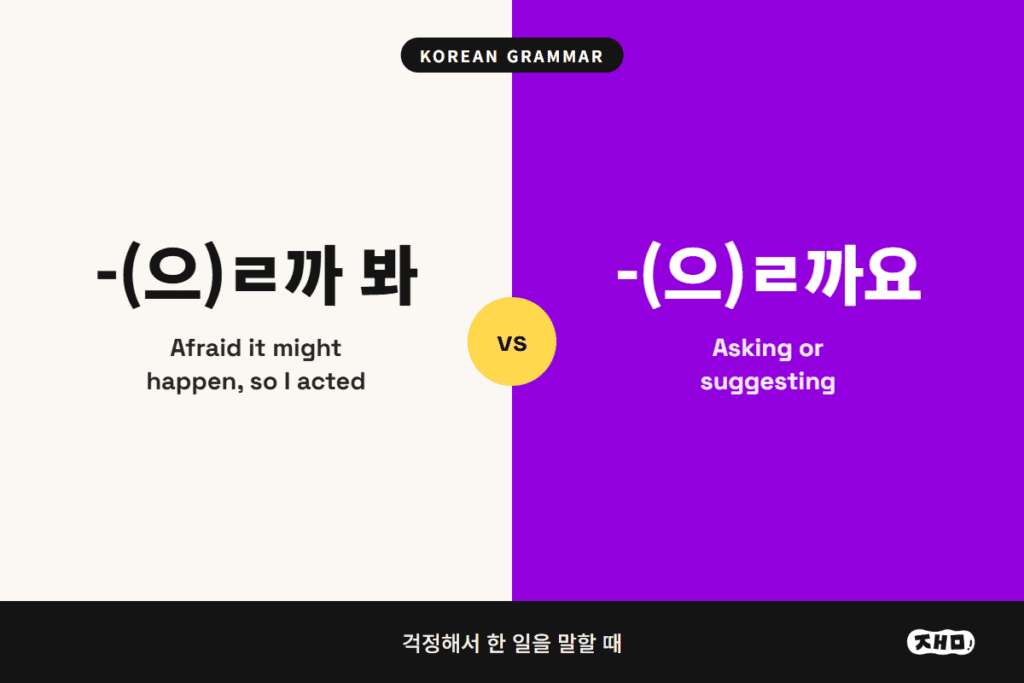
-(으)ㄹ까 봐 is the Korean grammar for a worry that made you act. You did something in case a bad thing happened.
늦을까 봐 택시를 탔어요 — I took a taxi because I was afraid I’d be late.
| At a glance | |
|---|---|
| Meaning | “because I was afraid that…” / “in case…” |
| Attaches to | a verb, an adjective, or a noun (일까 봐) |
| After it | the thing you did to prepare, usually in the past tense |
| Level | intermediate |
| Key point | the worry never has to come true |
This post covers the forms, when Koreans use it, eight example sentences, common mistakes, and how it differs from -(으)ㄹ까요 and -아서/-어서.
What -(으)ㄹ까 봐 means
The pattern has two parts:
- -(으)ㄹ까: a guess about the future or an uncertain situation
- 봐: from 보다, which here works as “it looks like”
Together they say “I’m worried it might turn out that…”. What comes after is the thing you did to prepare for that possibility.
| Stem | Form | Examples |
|---|---|---|
| ends in a vowel (or ㄹ) | -ㄹ까 봐 | 오다 → 올까 봐 · 잊어버리다 → 잊어버릴까 봐 · 놀다 → 놀까 봐 |
| ends in a consonant | -을까 봐 | 늦다 → 늦을까 봐 · 먹다 → 먹을까 봐 · 많다 → 많을까 봐 |
| ㅂ-irregular adjective | ㅂ → 우 + -ㄹ까 봐 | 춥다 → 추울까 봐 · 어렵다 → 어려울까 봐 |
| past worry | -았/었을까 봐 | 화가 났을까 봐 (afraid they might have been angry) |
| noun | 일까 봐 | 거짓말일까 봐 (afraid it’s a lie) |
The part before 봐 is the worry. The part after is your action: 챙겼어요, 일찍 나왔어요, 메모해 뒀어요.
When Koreans actually use -(으)ㄹ까 봐
1. Precaution
You bring an umbrella, leave early, write something down, or book in advance. -(으)ㄹ까 봐 names the risk you were guarding against. It often carries a small, relatable shyness: you are admitting that you worry.
2. Consideration for other people
아이가 깰까 봐 작게 말했어요 — I spoke quietly because I was afraid the child would wake up. The worry is on someone else’s behalf, so the sentence sounds thoughtful.
3. When nerves hold you back
내 한국어가 이상할까 봐 말을 못 했어요 — I couldn’t speak because I was afraid my Korean would sound strange. Learners say this one more than they’d like.
💬 In speech, the pattern can also end a sentence: 늦을까 봐요. It is short and a little soft, and the listener fills in what you did about it.
Eight -(으)ㄹ까 봐 example sentences
| Korean | English |
|---|---|
| 늦을까 봐 택시를 탔어요. | I took a taxi because I was afraid I’d be late. |
| 감기에 걸릴까 봐 따뜻하게 입었어요. | I dressed warmly because I was afraid of catching a cold. |
| 친구가 서운했을까 봐 먼저 전화했어요. | I called first because I was afraid my friend might have felt hurt. |
| 잊어버릴까 봐 휴대폰에 메모해 뒀어요. | I made a note on my phone because I was afraid I’d forget. |
| 너무 비쌀까 봐 가격을 먼저 물어봤어요. | I asked the price first because I was afraid it would be too expensive. |
| 아이가 깰까 봐 작게 말했어요. | I spoke quietly because I was afraid the child would wake up. |
| 내 한국어가 이상할까 봐 말을 못 했어요. | I couldn’t speak because I was afraid my Korean would sound strange. |
| 표가 매진될까 봐 미리 예매했어요. | I booked in advance because I was afraid the tickets would sell out. |
-(으)ㄹ까 봐 vs -(으)ㄹ까요 vs -아서/-어서
The first two look almost the same on the page, and learners mix them up for that reason. The third is about certainty.
| Pattern | What it does | Example |
|---|---|---|
| -(으)ㄹ까요? | a question or a suggestion | 비가 올까요? (Do you think it will rain?) · 같이 갈까요? (Shall we go together?) |
| -(으)ㄹ까 봐 | a reason with a worry inside it — it hasn’t happened | 비가 올까 봐 우산을 챙겼어요. (I brought an umbrella because I was afraid it would rain.) |
| -아서/-어서 | a reason that is already a fact | 비가 와서 우산을 챙겼어요. (It is already raining.) |
비가 와서 늦었어요. — I was late because it rained. (It really rained.)
비가 올까 봐 일찍 나왔어요. — I left early because I was afraid it would rain. (Maybe it never did.)
If the thing you are describing has not happened yet, -(으)ㄹ까 봐 is the right tool.
Common mistakes with -(으)ㄹ까 봐
Mistake 1: using it for a good outcome
- ❌ 합격할까 봐 기뻐요
- ✅ 합격했으면 좋겠어요
The pattern only works with a worry. For something you hope for, use -았/었으면 좋겠다.
Mistake 2: forgetting the past form
- ✅ 친구가 화가 났을까 봐 전화했어요 — afraid my friend might already be angry
- ✅ 친구가 화가 날까 봐 전화했어요 — afraid my friend would get angry later
When the worry is about something that may already have happened, use -았/었을까 봐.
Mistake 3: dropping the ㅂ-irregular change
- ❌ 춥을까 봐
- ✅ 추울까 봐 · 어려울까 봐
How we practice -(으)ㄹ까 봐 in Intensive
Patterns like this are the raw material of the Intensive Challenge.
- Weekly PDF: each pattern next to the one it gets confused with
- Daily missions: you produce your own sentences instead of recognising someone else’s
- Recorded group class: we go through those sentences together. The fixes are usually the ones above: a missing past form, the wrong choice between -(으)ㄹ까 봐 and -아서/-어서, a consonant change dropped in a hurry.
- 30-minute 1:1: you say the sentence out loud and the teacher corrects it on the spot
FAQ
Can -(으)ㄹ까 봐 end a sentence?
Yes, in speech. 늦을까 봐요 is a short, soft way to say “I’m afraid I’ll be late,” and it invites the listener to ask what you did about it. In writing, the pattern normally sits in the middle of a sentence with the action after it.
Is -(으)ㄹ까 봐 followed by 걱정돼요?
Often, but not always. 떨어질까 봐 걱정돼요 is a very common sentence, where the worry and the feeling share one clause. The pattern also works on its own, as in 떨어질까 봐 열심히 공부했어요, where the action replaces the feeling.
How do I say “in case” with -(으)ㄹ까 봐?
Use it exactly as in the examples: 비가 올까 봐 우산을 챙겼어요 is “I brought an umbrella in case it rained.” English gives you two ways to say it, “because I was afraid” and “in case,” and the Korean pattern covers both.
Where to go from here
Knowing the forms is not the same as producing one in the middle of a conversation. That is the gap the Intensive Challenge is built to close: a weekly PDF, daily missions, a recorded group class, and a 30-minute 1:1 every week where a teacher corrects you the moment you speak.
In six weeks, the words come out. And you feel confident using them. See how it works at jaem.io/programs/intensive-challenge. For another way to explain a reason, read -나 보다 vs -나 싶다, the grammar of guessing from what you see. If you’d rather meet a teacher first, start with our free lecture.
Know the grammar, but can’t say it yet?
문법은 아는데 말이 안 나와요?
There is a program for each level and goal. Tell us your level and we’ll point you to one.
About the author
Chris
Chris has taught Korean in Korea for over four years. He teaches TOPIK prep, business Korean, and intermediate to advanced speaking. He is also the head teacher of JAEM.
One Korean tip a week
뉴스레터 · 매주 한 번
A short email with Korean you can use this week. In English, with Korean examples.