In this article
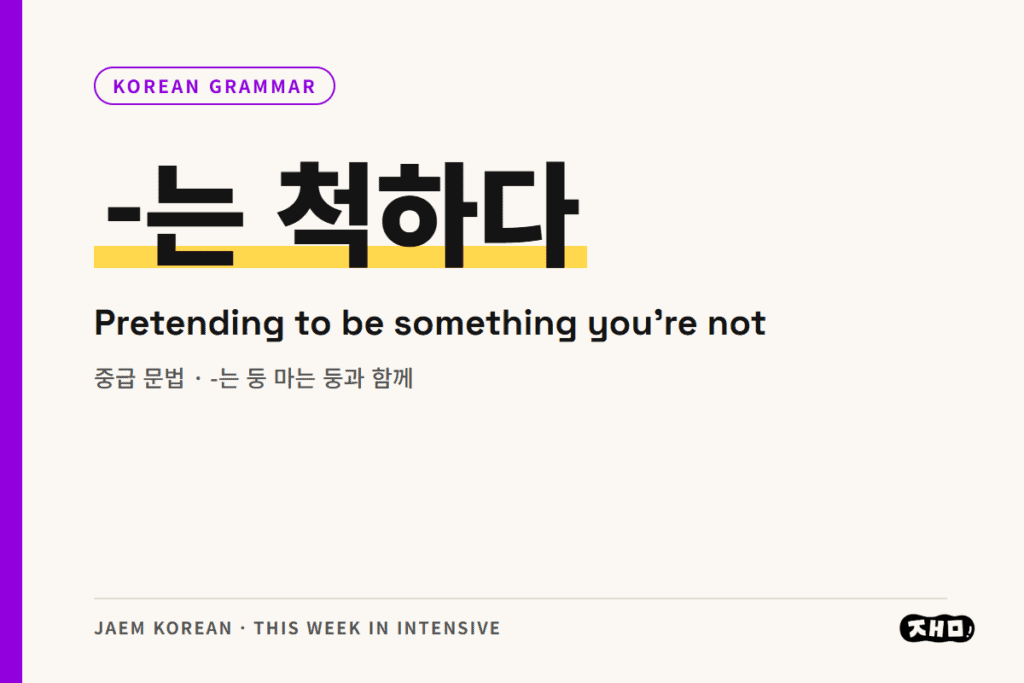
-는 척하다 is the Korean grammar for pretending: it attaches to a verb or adjective and means “to act as if, to put on a show of doing something you are not really doing.” It is a TOPIK II intermediate grammar point, and it is everywhere in drama dialogue and in ordinary office small talk — the coworker who pretends to be busy, the friend who pretends not to have heard. This post covers all four forms of -는 척하다, eight example sentences, the mistakes that keep coming back, and how it differs from the half-hearted -는 둥 마는 둥.
What -는 척하다 means
척하다 is a helping verb. It takes a modifier ending and turns whatever came before it into a performance. The ending you pick depends on the word class and the tense:
- Action verb, happening now → -는 척하다: 자는 척하다 (pretend to be sleeping), 읽는 척하다 (pretend to be reading)
- Action verb, already done → -(으)ㄴ 척하다: 먹은 척하다 (pretend to have eaten), 들은 척하다 (pretend to have heard)
- Adjetivo → -(으)ㄴ 척하다: 바쁜 척하다 (pretend to be busy), 괜찮은 척하다 (pretend to be fine)
- Sustantivo → 인 척하다: 학생인 척하다 (pretend to be a student), 전문가인 척하다 (pretend to be an expert)
You will also meet -는 체하다, which means the same thing and follows the same rules. 척하다 is far more common in speech; 체하다 sounds slightly more written.
The verb 하다 at the end carries the tense: 자는 척했어요, 자는 척할 거예요, 자는 척하지 마세요.
When Koreans actually use -는 척하다
Two situations dominate. The first is saving face. 괜찮은 척하다 — pretending to be fine — is the phrase Koreans use about themselves after a hard week, and it carries a quiet, sympathetic tone. It is not an accusation; it is an admission.
The second is avoidance. 못 들은 척하다 (pretend you didn’t hear it), 모르는 척하다 (pretend you don’t know), 안 본 척하다 (pretend you didn’t see) are set phrases for stepping around a situation you would rather not enter. In this use the tone tips toward criticism, especially when you say it about someone else.
There is a third, lighter use: showing off. 아는 척하다 means to act like you know something you don’t, and it is a very common piece of teasing between friends. Note that 아는 척하다 has drifted from a literal meaning into a fixed idiom — “to be a know-it-all.”
Eight -는 척하다 example sentences
아침에 알람이 울렸지만 자는 척하고 계속 누워 있었어요. — My alarm went off in the morning, but I pretended to be asleep and stayed in bed.
속상했는데 가족들 앞에서는 괜찮은 척했어요. — I was upset, but I acted fine in front of my family.
부장님이 지나갈 때만 바쁜 척하는 사람이 꼭 있어요. — There’s always someone who only acts busy when the manager walks past.
그 얘기는 못 들은 척해 주세요. — Please pretend you didn’t hear that.
모르는 척했지만 사실은 다 알고 있었어요. — I acted like I didn’t know, but actually I knew everything.
친구가 준 선물이 마음에 안 들었지만 좋아하는 척했어요. — I didn’t like the gift my friend gave me, but I pretended to.
한국어를 잘하는 척하다가 질문을 받고 당황했어요. — I was acting like my Korean was good, then got asked a question and froze.
어제 다 읽은 척했는데 사실은 반밖에 못 읽었어요. — I pretended I’d finished reading it yesterday, but actually I only got halfway.
Common mistakes with -는 척하다
Mistake 1: using -는 with adjectives. 바쁘는 척했어요 is the single most frequent error. Adjectives take -(으)ㄴ: 바쁜 척했어요, 괜찮은 척했어요, 아픈 척했어요. Only action verbs in the present take -는.
Mistake 2: putting the negation in the wrong place. “I pretended not to know” is 모르는 척했어요 — the negation belongs to the inner verb, not to 척하다. 알는 척 안 했어요 is wrong twice over: it breaks the ㄹ-drop rule (아는, not 알는) and it negates the pretending instead of the knowing. 안 척했어요 means you didn’t pretend at all, which is a different sentence.
Mistake 3: forgetting that tense lives on 하다. 자는 척하는 있었어요 comes from trying to conjugate the inner verb. Leave the inner verb in its modifier form and conjugate 하다: 자는 척하고 있었어요.
-는 척하다 vs -는 둥 마는 둥
The same Intensive week teaches -는 둥 마는 둥, and it is worth separating the two clearly, because both describe something that isn’t real effort.
- -는 척하다: you are not doing the thing at all. You are performing it. 공부하는 척했어요 — the book was open and nothing went in.
- -는 둥 마는 둥: you are doing the thing, but barely, half-attentively. 공부를 하는 둥 마는 둥 했어요 — you studied, just not seriously.
밥을 먹는 척했어요. — I pretended to eat. (The food is still on the plate.)
밥을 먹는 둥 마는 둥 했어요. — I picked at my food. (Some of it is gone.)
A quick test: if the action genuinely did not happen, use -는 척하다. If it happened badly, use -는 둥 마는 둥.
How we practice -는 척하다 in Intensive
This is the Monday grammar of the 10월 B week in our Desafío intensivo, the week we call “괜찮은 척.” The weekly PDF lays out the four forms of 척하다 next to -는 둥 마는 둥, and the Monday mission asks you to describe a moment when you kept a straight face — what you showed on the outside, what was true on the inside — using the frame “~척했지만, 사실은 ~.”
In the recorded group class we go through the sentences together, and the most common fixes are exactly the two mistakes above: the 는/은 choice and where the negation goes. The week’s 1:1 conversation cards move the pattern into speech with prompts about pretending at work, at home, and with friends. Then in your weekly 30-minute 1:1, you answer out loud and the teacher corrects each sentence the moment it’s said.
Preguntas frecuentes
What is the difference between -는 척하다 and -는 체하다?
They mean the same thing and follow the same conjugation rules. 척하다 is more common in everyday speech, while 체하다 has a slightly more formal, written feel. You can safely use 척하다 in every situation.
How do I use -는 척하다 with adjectives?
Adjectives take -(으)ㄴ, not -는: 바쁜 척하다, 괜찮은 척하다, 아픈 척하다. Nouns take 인 척하다: 부자인 척하다. Only present-tense action verbs take -는.
Is -는 척하다 rude to say about another person?
It can be. Said about yourself it usually sounds honest or self-deprecating. Said about someone else — especially 아는 척하다 or 못 들은 척하다 — it is a criticism, so keep it for friends or for situations where the judgment is intended.
Where to go from here
Knowing the four forms of -는 척하다 is not the same as producing one in the middle of a conversation. That is the gap the Intensive Challenge is built to close: a weekly PDF, daily missions, a recorded group class, and a 30-minute 1:1 every week where a teacher corrects you the moment you speak.
In six weeks, the words come out. And you feel confident using them. See how it works at jaem.io/programs/intensive-challenge. Thursday’s post covers the expression from the same week — 시치미를 떼다, the idiom for playing dumb, which is 모르는 척하다 with four hundred years of history behind it. If you’d rather meet a teacher first, start with our free lecture.
Know the grammar, but can’t say it yet?
문법은 아는데 말이 안 나와요?
There is a program for each level and goal. Tell us your level and we’ll point you to one.

About the author
Chris
Chris has taught Korean in Korea for over four years. He teaches TOPIK prep, business Korean, and intermediate to advanced speaking. He is also the head teacher of JAEM.
One Korean tip a week
뉴스레터 · 매주 한 번
A short email with Korean you can use this week. In English, with Korean examples.