In this article
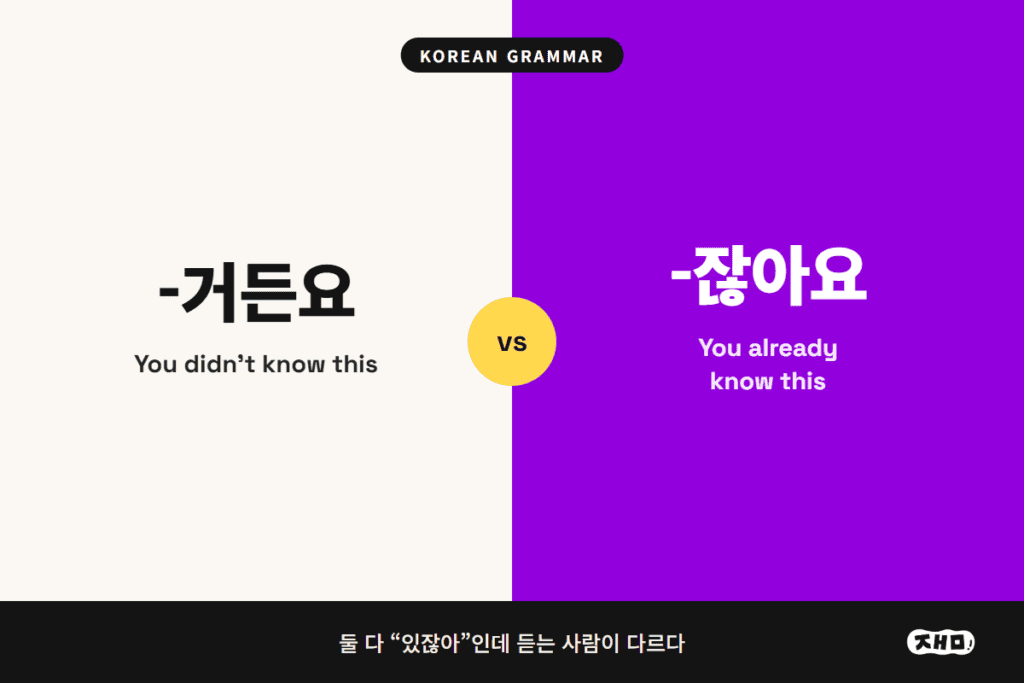
-거든요 y -잖아요 are two Korean sentence endings that both get translated as “you see” or “you know” — the difference is that -거든요 supplies a reason the listener does not have yet, while -잖아요 points at one they already share. Both are TOPIK II intermediate grammar, both are everywhere in spoken Korean, and both are conversational endings you will almost never see in a newspaper. This post separates them with a single decision question, nine examples, and the mix-ups that keep learners guessing.
Picture it in one scene. You ask a Korean friend why she is leaving the party early: 내일 아침 일찍 출근하거든요. Ten minutes later someone complains about the cold and she says 지금 1월이잖아요. Same speaker, same conversational job — giving a reason — and yet she switched endings. Here is why.
What -거든요 means
-거든요 attaches to a verb, adjective, or noun (with 이) and supplies background the listener probably does not have. The tone is “here’s the thing you didn’t know.” It usually arrives as a second sentence explaining the first one, and it can carry a small note of pride or self-emphasis.
Where it shows up most:
- Explaining why you can’t do something — “I have to be up early, you see.”
- Setting up a story — “This was my first trip abroad, you see.”
- A soft brag — “I lived in Korea for years, that’s why.”
Think of -거든요 as the ending that opens a door. The listener did not know, and now you are letting them in. In casual speech the 요 drops: -거든.
What -잖아요 means
-잖아요 attaches the same way but points at something the listener already knows, or should know. The tone is “you know this already, remember?” It closes a door the listener was pretending was open: “we already talked about this,” “it’s late,” “you saw the forecast.”
One detail learners notice quickly: -잖아요 said flat is a reminder. Said with a sharp rise at the end, it becomes a complaint. The grammar is identical; the emotion lives in the voice. Casual form: -잖아.
-거든요 vs -잖아요: the one-question test
The quickest test is a single question: does the listener already know this?
| -거든요 | -잖아요 | |
|---|---|---|
| Listener’s knowledge | New to them | Already shared |
| Typical feel | “Here’s why” | “You know that” |
| Risk if misused | Sounds like over-explaining | Sounds bossy or annoyed |
| Casual form | -거든 | -잖아 |
A friend asks why you didn’t answer a text. If the reason is something they could not have known, use -거든요: 어제 폰이 고장 났거든요. If the reason is something you told them a week ago, use -잖아요: 나 어제 시험이었잖아요. Same situation, opposite ending — and the choice tells the listener how much you expected them to remember.
The same pair of endings has been compared on plenty of grammar sites, so what we’ve tried to add here is density: more sentences, and the two mistakes that actually come up in class.
Nine example sentences
오늘은 커피 안 마실래요. 요즘 잠을 잘 못 자거든요. — I’ll skip coffee today. I haven’t been sleeping well lately, you see.
이 동네 잘 알아요. 고등학교 때 여기 살았거든요. — I know this neighborhood well. I lived here in high school.
제가 요리를 좀 해요. 엄마가 식당을 하셨거든요. — I can cook a bit. My mom ran a restaurant, that’s why.
늦어서 미안해요. 버스를 잘못 탔거든요. — Sorry I’m late. I got on the wrong bus.
저 다음 주에 못 와요. 그때 시험이 있거든요. — I can’t come next week. I have an exam then.
우산 가져가세요. 아침에 비 온다고 했잖아요. — Take an umbrella. They said it would rain this morning, remember?
왜 놀라요? 제가 미리 말했잖아요. — Why are you surprised? I told you in advance.
지금 못 나가요. 밖에 너무 춥잖아요. — I can’t go out now. It’s freezing outside, you know.
그 카페 문 닫았잖아요. 다른 데 가요. — That café closed down, remember? Let’s go somewhere else.
Read the first five and the last four out loud back to back. The 거든요 group all feel like new information landing; the 잖아요 group all feel like something being picked back up off the table.
Common mistakes
Mistake 1: using -잖아요 for new information. A student tells a teacher she has just met, 저는 한국 드라마 좋아하잖아요. He has no way of knowing that, so the sentence lands as if she is scolding him for forgetting. Fix: 저는 한국 드라마 좋아하거든요. Rule of thumb — if you would be surprised that your listener didn’t know, -잖아요 is safe. Otherwise, -거든요.
Mistake 2: opening a conversation with -거든요. -거든요 explains a sentence that came before it. Dropping it in cold — 어제 늦게 잤거든요 with nothing in front — leaves the listener waiting for the point. Say what happened first, then supply the reason: 오늘 좀 피곤해요. 어제 늦게 잤거든요.
Mistake 3: dropping the 이 after a consonant-final noun. It is 학생이거든요 y 학생이잖아요, never 학생거든요.
How we practice these endings in Intensive
Both endings come from real weeks of our Desafío intensivo: -거든요 sits in the April Week A material on old memories, and -잖아요 in May Week A. Each weekly PDF opens with a mission, moves through ten key words, and then reaches the Monday and Tuesday grammar pages where these endings live. The explanation is short; the practice is where the time goes.
The pattern section builds each ending into sentence frames you rebuild with your own life, and the 1:1 dialogue card at the end of the week asks you to use it in a two-way conversation, not a fill-in-the-blank. In the recorded group class the teacher listens for exactly the mix-up above and corrects it the moment it happens, which is when a correction actually sticks. Your weekly 30-minute 1:1 is where the -잖아요 that came out sounding like a complaint gets rehearsed until it sounds like a reminder.
Preguntas frecuentes
What is the difference between -거든요 and -잖아요 in Korean?
-거든요 introduces a reason or background the listener does not know yet; -잖아요 points at information the two of you already share. Ask yourself whether the listener already knows the fact — that single question decides the ending.
Is -잖아요 rude?
It can be, if the listener genuinely didn’t know the information, or if your tone rises sharply. Said calmly, to someone who does know, it is a normal reminder. Many learners avoid it entirely out of caution, which makes their Korean sound stiff. Use it, but only for shared facts.
Can -거든요 and -잖아요 be used in formal writing?
Not really. Both are spoken endings. In a report or a formal email, give the reason with -기 때문에 or -아/어서 instead. In a message to a friend, -거든 and -잖아 are perfectly natural.
Where to go from here
Reading the difference is the easy part. Producing the right one, at the right moment, while somebody waits for your answer, is a different skill — and it is what the Intensive Challenge is built around: weekly PDFs, daily missions, recorded group classes, and a 30-minute 1:1 every week where your sentences get corrected on the spot instead of days later.
In six weeks, the words come out. And you feel confident using them. See how it works at jaem.io/programs/intensive-challenge. Thursday’s post covers the expression half of the same week — 리즈 시절 and 흑역사 — two slang words that pair naturally with -거든요 when you tell stories about your past. Not ready to commit? Start with a free lecture.
Know the grammar, but can’t say it yet?
문법은 아는데 말이 안 나와요?
There is a program for each level and goal. Tell us your level and we’ll point you to one.

About the author
Chris
Chris has taught Korean in Korea for over four years. He teaches TOPIK prep, business Korean, and intermediate to advanced speaking. He is also the head teacher of JAEM.
One Korean tip a week
뉴스레터 · 매주 한 번
A short email with Korean you can use this week. In English, with Korean examples.