In this article
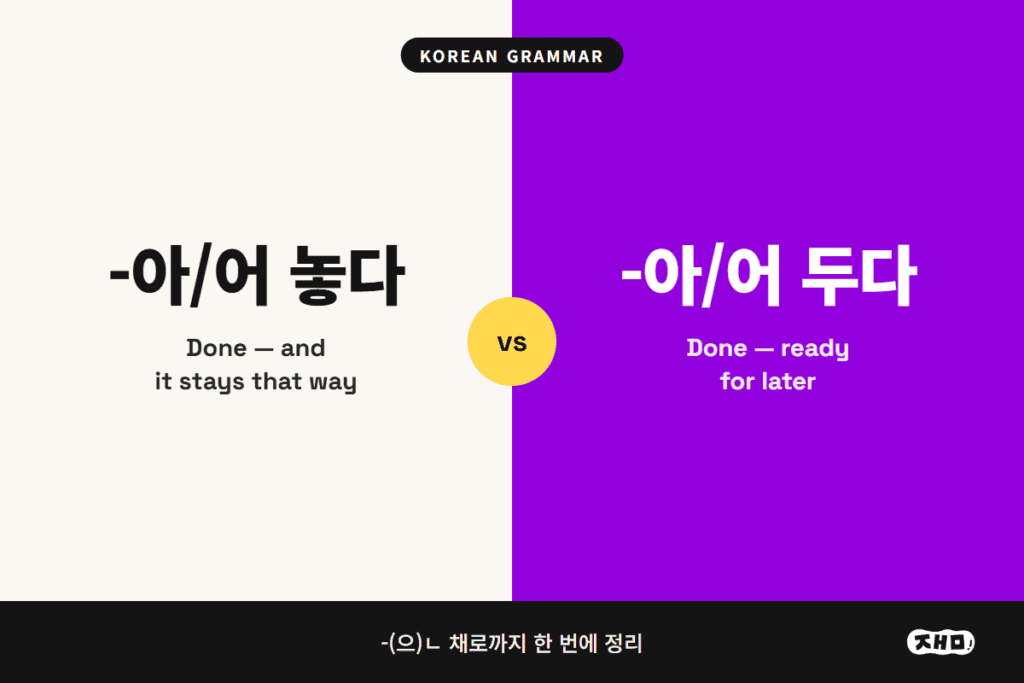
-아/어 놓다 y -아/어 두다 are the two Korean patterns for “do the action, and let the result stay” — you ironed the shirt last night, you left the window open, and it is still that way now. Both are TOPIK II intermediate grammar, both attach straight to a verb, and most of the time they are interchangeable. This post is about the times they are not, plus the third pattern learners keep confusing with both: -(으)ㄴ 채로, for doing something while a previous state is still in place.
Our Intensive students learn the forms in an afternoon and then ask the same question for a week: “But which one — 놓다 or 두다?” Short answer below, with nine examples and the three mistakes that actually cost you meaning.
What -아/어 놓다 and -아/어 두다 mean
Take 열다 (to open). 창문을 열어 놓다 and 창문을 열어 두다 both mean you opened the window and it is still open.
The nuance is small but real:
- -아/어 놓다 stresses the resulting state. The action is done and the outcome is sitting there in front of you.
- -아/어 두다 leans toward preparation. You did it now so that it is ready for later.
In everyday speech the two overlap so heavily that Koreans swap them without thinking. Where they diverge is in what the sentence points at: 놓다 points at the state, 두다 points at the future use.
There is also a pronunciation shortcut worth knowing. In fast speech, past-tense -아/어 놓다 shrinks to -아/어 놨- (해 놨어요) and 두다 becomes 뒀- (해 뒀어요). Both are standard.
When Koreans reach for 두다, and when for 놓다
Listen for it and you will notice 두다 clustering around planning verbs: 미리 사 두다 (buy in advance), 예약해 두다 (book ahead), 알아 두다 (keep in mind), 외워 두다 (memorize for later). The “for later” feeling is baked in, and 미리 (in advance) shows up beside it constantly.
놓다 clusters around visible results: 불을 켜 놓다 (leave the light on), 문을 잠가 놓다 (lock the door and leave it), 책상 위에 올려 놓다 (put it on the desk and leave it there). You can point at the outcome.
That is the practical version of the rule. If the sentence is about being ready, 두다 fits a little better. If it is about how the room looks right now, 놓다 does.
-(으)ㄴ 채로: with something still on
-(으)ㄴ 채로 looks similar and does a different job. It means “while keeping the state of a previous action,” usually one that would normally be undone first. You fell asleep with your makeup still on. You walked in with your shoes still on. 채 is a bound noun, so it always follows -(으)ㄴ, and the 로 is optional: 쓴 채로 or 쓴 채.
The difference from 놓다/두다: those describe the act of leaving something in a state. 채로 describes doing a second action while the first state is still in place, and it often carries a hint that the state should have been changed.
- 창문을 열어 놓았어요. — I opened the window and left it open. (neutral, just a fact)
- 창문을 연 채로 잤어요. — I slept with the window open. (a second action, with a faint “oops”)
Quick rule: if there is a second verb happening, and the first state is unusual for it, you want 채로.
Nine example sentences
내일 면접이 있어서 정장을 미리 다려 두었어요. — I have an interview tomorrow, so I ironed my suit in advance.
고양이 때문에 방문을 조금 열어 놓았어요. — I left the bedroom door open a little for the cat.
비밀번호는 꼭 어디에 적어 두세요. — Be sure to write your password down somewhere for later.
택배가 오면 경비실에 맡겨 놓으라고 했어요. — I asked them to leave the package at the security office if it arrives.
친구가 온다고 해서 냉장고에 음료수를 채워 뒀어요. — A friend said she’s coming, so I stocked the fridge with drinks.
손님 오시기 전에 거실 불을 켜 놨어요. — I turned the living room lights on before the guests arrived.
안경을 낀 채로 세수를 했어요. — I washed my face with my glasses still on.
너무 피곤해서 불을 켠 채로 잠들었어요. — I was so tired I fell asleep with the light on.
신발을 신은 채로 침대에 올라가지 마세요. — Don’t get on the bed with your shoes on.
Common mistakes
Mistake 1: using -고 있다 where -아/어 놓다 belongs. Students write 문을 열고 있어요 to say “the door is left open,” but that means “I am in the middle of opening the door.” For a state you created and left, use 열어 놓았어요. For a state that simply exists with no agent behind it, 열려 있어요 (“it is open”) is the natural choice.
Mistake 2: putting 채로 on an action rather than a state. 밥을 먹은 채로 나갔어요 sounds off, because eating is not a state you keep. 채로 works with verbs whose result lingers on the body or the scene: 입다, 쓰다, 신다, 켜다, 열다, 앉다. If your first verb is not one of those, reach for -고 나서 (“after doing”) or -지 않고 (“without doing”).
Mistake 3: freezing over 놓다 vs 두다. We watch students stop mid-sentence trying to choose. Pick one and keep talking. If a native speaker adjusts it, the correction will almost always be a suggestion about emphasis, not a grammar error.
How we practice this in Intensive
These three come from the fashion-and-outfit week of our Desafío intensivo, where the theme is planning what to wear and describing how something looks on you. The weekly PDF introduces 놓다/두다 first, then -아/어 있다 and -고 있다 for resulting and wearing states, then -(으)ㄴ 채로 — so the ways of talking about “a state that continues” sit side by side and you can feel the borders between them.
The pattern drills follow a reason-then-preparation shape (a -(으)니까 clause followed by 두다) and a habit shape (-(으)ㄴ 채로 followed by -기도 하다), so you build sentences from a frame instead of memorizing them. Students write three of their own for the Tuesday mission and read them in the recorded group class, where the -고 있다 mix-up turns up almost every week. In the weekly 30-minute 1:1, the dialogue cards are shopping and getting-ready scenarios, which give the teacher a natural reason to ask “did you leave that on?” and let you answer with the right pattern in real time.
Preguntas frecuentes
Can -아/어 놓다 and -아/어 두다 always be swapped?
Almost always. The meaning stays the same; only the emphasis shifts. 두다 leans toward “in preparation for later,” 놓다 toward “and it’s still like that.” If in doubt, either one is understood.
What is the difference between -(으)ㄴ 채로 and -(으)면서?
-(으)면서 joins two actions happening at the same time (음악을 들으면서 공부해요 — I study while listening to music). -(으)ㄴ 채로 joins a completed state and a new action (안경을 쓴 채로 잤어요 — I slept with my glasses on). If the first verb is something you finished and then kept, use 채로.
Is 채로 the same as 채?
Yes. The 로 is optional. 쓴 채 and 쓴 채로 mean the same thing; 채로 is a little more common in speech, 채 a little more common in writing.
Where to go from here
These forms are easy to memorize and easy to misuse, because the choice hinges on whether you are describing a result, a preparation, or a state you carried into the next action. That is a judgment you make mid-sentence, and it only gets reliable through practice with feedback.
In six weeks, the words come out. And you feel confident using them — see how the six weeks are structured at jaem.io/programs/intensive-challenge. Thursday’s post covers the expression half of the same fashion week, 추구미 and the slang for an outfit that works. And the free lecture is a good first look at how we teach.
Know the grammar, but can’t say it yet?
문법은 아는데 말이 안 나와요?
There is a program for each level and goal. Tell us your level and we’ll point you to one.

About the author
Chris
Chris has taught Korean in Korea for over four years. He teaches TOPIK prep, business Korean, and intermediate to advanced speaking. He is also the head teacher of JAEM.
One Korean tip a week
뉴스레터 · 매주 한 번
A short email with Korean you can use this week. In English, with Korean examples.