In this article
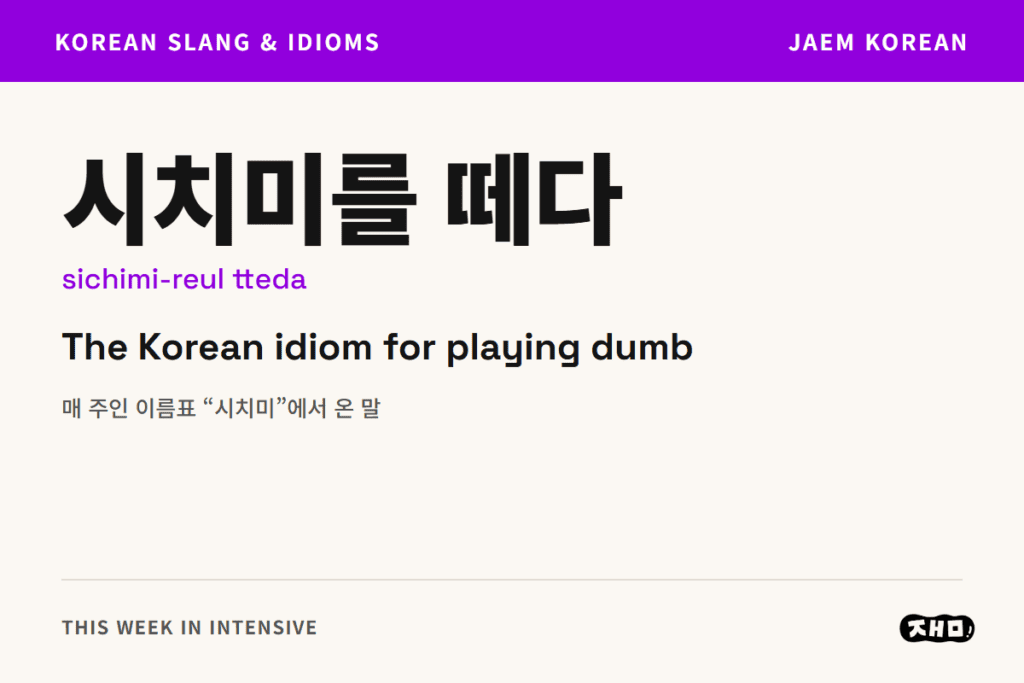
시치미를 떼다 means to play dumb — to act as if you don’t know something you clearly know, or as if you didn’t do something you clearly did. English gets close with “play innocent” or “act like nothing happened.” Korean has a whole family of phrases for this move, and this one is the sharpest of them.
There’s a scene that repeats in almost every Korean drama. Someone has obviously done it — read the message, taken the last piece of cake, told the secret — and when confronted they tilt their head: “뭐? 무슨 말이야?” The other character narrows their eyes and delivers the line.
How Koreans say “playing dumb”
Before the idiom, know the plain machinery, because you’ll need both.
The neutral, grammatical way is 모르는 척하다, “to pretend not to know.” It’s built from -는 척하다, the pretending pattern we covered in Monday’s grammar post, and it works in any register.
동생이 제 과자를 먹고 모르는 척했어요. — My younger sibling ate my snacks and pretended not to know.
바쁜 척하지 말고 솔직히 말해요. — Don’t act busy, just tell me honestly.
Then there are the idioms, each with a slightly different flavor: 시치미를 떼다 (deny what you know, about your own involvement), 딴청을 피우다 (visibly change the subject), 오리발을 내밉니다 (flatly deny), 능청을 떨다 (brazen it out with a straight face). Native speakers pick between them by how guilty the person is and how playful the accusation is.
괜히 딴청 피우지 말고 이리 와 봐요. — Stop looking the other way and come here.
시치미를 떼다: meaning and its falconry origin
The origin is one of the best stories in Korean idiom. In the Goryeo period, hunting with trained falcons was a pastime of the elite, and a good bird was valuable property. Owners tied a small tag — a 시치미 — to the falcon’s tail feathers, engraved with the owner’s name and address. If the bird flew off and someone else caught it, an honest finder read the tag and returned it. A dishonest one would 떼다 (tear off, remove) the 시치미, claim the falcon as their own, and act blank when the real owner came asking.
Seven or eight hundred years later nobody hunts with falcons, but the image survived. When you 시치미를 떼다, you have removed the evidence from your own face.
A form note: the full idiom carries 를, but in speech the particle nearly always drops.
시치미 떼지 마. — Don’t play dumb.
끝까지 시치미를 뗐어요. — He kept playing innocent right to the end.
시치미 떼도 소용없어요. 다 알고 있어요. — Playing dumb won’t help. I know everything.
Two mini dialogues
Dialogue 1 — Roommates and a missing snack
A: 냉장고에 있던 케이크 누가 먹었어? — Who ate the cake that was in the fridge?
B: 케이크? 무슨 케이크? — Cake? What cake?
A: 시치미 떼지 마. 입가에 크림 묻었어. — Don’t play dumb. You’ve got cream on your mouth.
B: 아… 조금만 먹으려고 했는데. — Ah… I only meant to have a little.
Dialogue 2 — Coworkers and a leaked plan
A: 우리 팀 이사 간다는 얘기, 어떻게 벌써 다 알고 있지? — How does everyone already know our team is relocating?
B: 글쎄요, 저는 처음 듣는데요. — No idea, this is the first I’ve heard of it.
A: 어제 점심때 본인이 말했잖아요. 시치미 떼도 소용없어요. — You said it yourself at lunch yesterday. Playing innocent won’t help.
B: 아, 그게… 그렇게 퍼질 줄 몰랐어요. — Oh, that… I didn’t think it would spread like that.
In both dialogues the idiom appears in the accusation, not the confession. That’s its usual position: someone else calls out your act.
Similar and opposite expressions
모르는 척하다 — the plain grammar version, and the topic of Monday’s post. Often interchangeable, but 시치미 implies you’re hiding your own guilt, not just withholding information.
딴청을 피우다 / 딴전을 부리다 — to feign indifference, to look the other way. More about visibly dodging the topic — suddenly checking your phone — than about verbal denial.
오리발을 내밀다 — literally “to hold out a duck’s foot,” from the image of a chicken thief presenting a duck’s foot as proof of innocence. Blunter and more confrontational than 시치미. 증거가 있는데도 오리발을 내밀었어요. — Even with the evidence in front of him, he flatly denied it.
능청을 떨다 — to act sly and shameless while keeping a straight face. Overlaps with 시치미 but adds a playful edge.
For the other direction, Korean uses 솔직하게 말하다 (speak honestly), 자백하다 (confess), and the very casual 털어놓다 (spill everything). 시치미 떼지 말고 다 털어놔. — Stop playing dumb and tell me everything.
When not to use it
Because 시치미를 떼다 asserts that the other person is guilty and knows it, it is an accusation. Between friends over a snack, it’s teasing. Aimed at a boss, a client, or someone older you don’t have that closeness with, it’s rude — you’re calling them a liar with a smile.
In formal settings, soften it. 혹시 알고 계셨던 건 아니에요? — Is it possible you already knew? — does the same work without the idiom. Or fall back on the neutral grammar: 모르는 척하시는 것 같은데요 is still pointed, but much less so.
Also, don’t stretch it to pretending in general. 시치미 is specifically about denying knowledge or involvement. Pretending to be sick, busy, or fine are all 척하다 jobs, not 시치미 jobs.
How we practice this in Intensive
시치미를 떼다 is the Wednesday expression of the 10월 B week in our Intensive Challenge, the week themed “괜찮은 척.” The weekly PDF introduces it alongside two related expressions and a model dialogue in which one person confesses to having bluffed through a meeting. The Wednesday mission asks you to write about a time you — or someone near you — played dumb, and how it ended. You bring that to the recorded group class, where we work on delivery: the idiom lands very differently depending on tone, so we practice both the teasing version and the sharp one. The 1:1 conversation cards give you prompts to accuse, deny, and confess, and in your weekly 30-minute 1:1 the teacher corrects your phrasing on the spot.
Idioms with a story stick. Students who hear the falcon tag once almost never forget what 시치미 means; the practice is about getting it out at the right moment.
자주 묻는 질문
What does 시치미를 떼다 mean in Korean?
It means to play dumb: to act as though you don’t know something you do know, or didn’t do something you did. It’s an idiom, used most often as an accusation aimed at someone who is denying their own involvement.
Where does the idiom 시치미를 떼다 come from?
시치미 was an owner’s name tag tied to a hunting falcon’s tail feathers in the Goryeo period. 떼다 means to remove. Tearing off the tag, claiming the bird, and acting innocent became the picture for denying what you obviously know.
Is 시치미를 떼다 rude?
It’s an accusation, so it depends on the relationship. Between friends it’s teasing. To someone senior or in a formal setting it can sound like calling them a liar. Use 모르는 척하시는 것 같은데요 or a softer question instead.
Where to go from here
You can learn 시치미를 떼다 from a drama subtitle in ten seconds. Being able to say “시치미 떼지 마” to a friend at exactly the right moment, with the right tone, takes practice with someone who’ll tell you when it lands wrong. That’s the Intensive Challenge: a weekly PDF, daily missions, a recorded group class, and a 30-minute 1:1 every week with immediate correction.
In six weeks, the words come out. And you feel confident using them. See the program at jaem.io/programs/intensive-challenge. Monday’s post covered the grammar from the same week, -는 척하다, which is the engine behind this idiom. And if you’d like to meet a teacher before committing, our free lecture is open.
Know the grammar, but can’t say it yet?
문법은 아는데 말이 안 나와요?
There is a program for each level and goal. Tell us your level and we’ll point you to one.

About the author
크리스
Chris has taught Korean in Korea for over four years. He teaches TOPIK prep, business Korean, and intermediate to advanced speaking. He is also the head teacher of JAEM.
One Korean tip a week
뉴스레터 · 매주 한 번
A short email with Korean you can use this week. In English, with Korean examples.