In this article
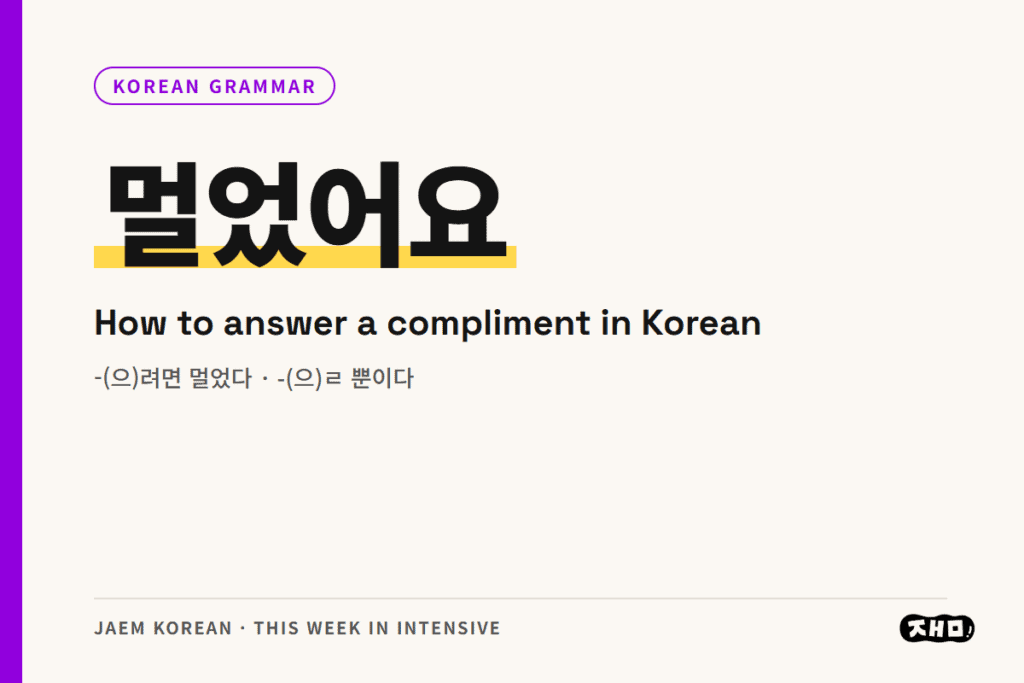
How to respond to compliments in Korean comes down to one rule: you deflect rather than accept. Where an English speaker says “thank you,” a Korean speaker usually answers a compliment by lowering the claim — “no, not at all,” “I still have a long way to go,” “I just got lucky.” Saying 감사합니다 alone is not wrong, but it can land flat, because the expected move is a small, warm denial. This post gives you the three levels of that move: the everyday one-word replies, the pattern -(으)려면 멀었다, and the TOPIK II intermediate grammar point -(으)ㄹ 뿐이다.
How to respond to compliments in Korean: the three moves
Move one: the reflex denial. 아니에요 is the default and works everywhere. 별말씀을요 is its more formal cousin, used with people older or senior to you — it literally brushes the compliment aside as “not worth saying.” 에이, 뭘요 is the casual version among friends. Any of these can stand alone as a complete reply.
Move two: point at the distance left. This is where -(으)려면 멀었다 lives. It says the goal is still far off, which reframes the compliment as premature rather than false.
Move three: shrink the cause. This is -(으)ㄹ 뿐이다 — “I only did X,” “it was just luck.” You accept that the thing happened, but you make the reason as small as possible.
Most natural replies stack two of these: 아니에요, 아직 멀었어요. Or 그냥 운이 좋았을 뿐이에요.
-(으)려면 멀었다: “I still have a long way to go”
The full form is -(으)려면 멀었다 — verb stem + -(으)려면, then 멀었다. 잘하려면 멀었어요. But the phrase you will actually hear most is the shortened 아직 멀었어요, which stands alone and needs no verb at all.
The tense is past (멀었다), even though the meaning is present. That surprises learners every time. Think of it as “the distance has been set” rather than “it is far.”
Two things to watch. First, 멀었어요 said about someone else is not modest, it is a put-down: 너는 아직 멀었어 means “you’re nowhere near ready.” Keep it pointed at yourself. Second, it is genuinely about skill and progress, so it fits compliments about your Korean, your cooking, your work — not compliments about your appearance or your clothes.
-(으)ㄹ 뿐이다: “I just did X, that’s all”
-(으)ㄹ 뿐이다 attaches to a verb or adjective stem and means “only, nothing more than.” For something already finished, use the past form -았/었을 뿐이다: 시킨 대로 했을 뿐이에요 — I only did what I was told.
As a compliment reply it almost always arrives with 그냥 in front: 그냥 운이 좋았을 뿐이에요. The 그냥 does a lot of the softening work; without it the sentence can sound clipped.
Note the difference from 만: 만 marks a limited thing (커피만 마셨어요 — I drank only coffee), while -(으)ㄹ 뿐이다 limits the whole statement (커피를 마셨을 뿐이에요 — all I did was drink coffee, nothing more happened). For deflecting praise you want the second one, because you are shrinking the significance of the act, not counting items.
Eight ways to answer a compliment in Korean
한국어 정말 잘하시네요! — 아니에요, 아직 멀었어요. — “Your Korean is really good!” “No, I still have a long way to go.”
별말씀을요, 부장님 덕분입니다. — Not at all, it’s thanks to you.
에이, 뭘요. 그냥 열심히 했을 뿐이에요. — Oh, it’s nothing. I just worked hard, that’s all.
제 실력으로 발음까지 자연스러우려면 멀었어요. — At my level, natural pronunciation is still a long way off.
운이 좋았을 뿐이에요. 문제가 쉽게 나왔어요. — I just got lucky, the questions happened to be easy.
요리를 잘한다니요, 레시피대로 따라 했을 뿐인데요. — Me, good at cooking? I only followed the recipe.
칭찬 감사합니다. 그런데 아직 배우는 중이에요. — Thank you for the compliment, but I’m still learning.
혼자 한 게 아니라 팀이 다 해 줬을 뿐이에요. — I didn’t do it alone; the team did all of it, really.
Common mistakes when responding to compliments
Mistake 1: 멀었어요 aimed at the other person. 아직 멀었어요 about yourself is modest. 너 아직 멀었어 about your conversation partner means “you’re not good enough yet.” Learners produce this by accident all the time when trying to be humble on someone else’s behalf.
Mistake 2: using -(으)ㄹ 뿐이다 where 만 belongs. 물뿐이에요 to mean “there’s only water” is a different construction from 물만 있어요. For quantities and items, use 만. Keep -(으)ㄹ 뿐이다 for shrinking an action or a state.
Mistake 3: over-denying. Three refusals in a row stops sounding modest and starts sounding like you are arguing with the compliment. One denial plus one reason is the natural shape: 아니에요, 그냥 운이 좋았어요. After that, accept it — 감사합니다 closes the exchange gracefully.
How we practice compliment replies in Intensive
-(으)려면 멀었다 belongs to the 9월 A week of our Intensive Challenge, whose theme is “실력이 느는 속도” — the speed at which skill grows. The weekly PDF introduces it next to 이르다 and -는 한, then the pattern drills combine it with -기는 했는데 so you can say “I did improve, but I’m still far from X.” That is the exact sentence every intermediate learner needs when a Korean friend asks how the studying is going.
-(으)ㄹ 뿐이다 arrives in the 10월 B week (“괜찮은 척”), where the pattern drill is the compliment reply itself: 그냥 …았/었을 뿐이에요. You write three sentences of your own for the mission, and the teacher fixes the tense and the register in your weekly 30-minute 1:1. Group classes are recorded, so if you miss the live session you still hear how the other students downplayed their wins.
자주 묻는 질문
Is it rude to just say 감사합니다 when someone compliments you in Korean?
Not rude, but it can feel abrupt in a culture where deflecting is the expected first move. The safest pattern is a short denial followed by thanks: 아니에요, 감사합니다. In business settings with a clear compliment on your work, 감사합니다 on its own is perfectly fine.
What does 아직 멀었어요 mean exactly?
It means “I still have a long way to go.” The full grammar is -(으)려면 멀었다, but the shortened 아직 멀었어요 stands alone as a complete, modest answer about your own skill. Do not say it about another person, where it becomes an insult.
When should I use -(으)ㄹ 뿐이다 instead of 만?
Use 만 to limit a noun (커피만 마셨어요 — only coffee). Use -(으)ㄹ 뿐이다 to limit the whole statement (커피를 마셨을 뿐이에요 — all I did was drink coffee). For deflecting praise you want -(으)ㄹ 뿐이다, usually with 그냥 in front.
Where to go from here
Compliment replies are pure reflex. You cannot look them up mid-conversation — either 아니에요, 아직 멀었어요 comes out in half a second or it doesn’t.
That reflex is built by saying it out loud, many times, with someone correcting you. The Intensive Challenge gives you a weekly PDF, daily missions, a recorded group class, and a 30-minute 1:1 every week where the teacher fixes the sentence as it leaves your mouth. In six weeks, the words come out. And you feel confident using them. See the program at jaem.io/programs/intensive-challenge. Thursday’s post takes the expressions from the same week — Korean idioms for feeling stuck, including 갈 길이 멀다, the idiom sitting right behind 아직 멀었어요. Want to meet a teacher first? Start with our free lecture.
Know the grammar, but can’t say it yet?
문법은 아는데 말이 안 나와요?
There is a program for each level and goal. Tell us your level and we’ll point you to one.

About the author
크리스
Chris has taught Korean in Korea for over four years. He teaches TOPIK prep, business Korean, and intermediate to advanced speaking. He is also the head teacher of JAEM.
One Korean tip a week
뉴스레터 · 매주 한 번
A short email with Korean you can use this week. In English, with Korean examples.