In this article
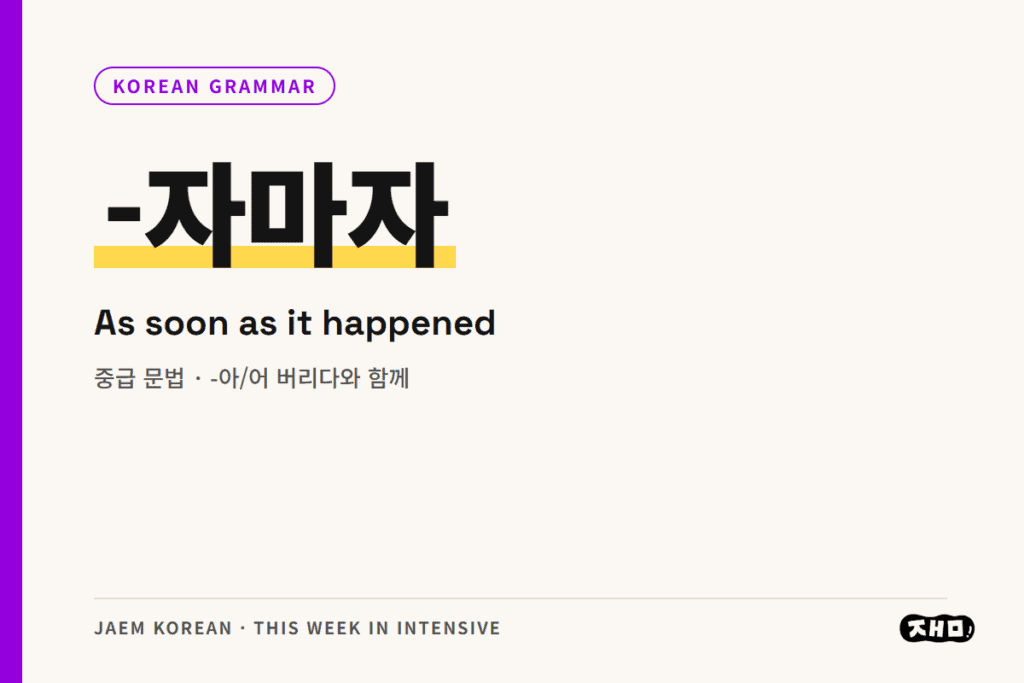
-자마자 is the Korean connector that means “as soon as” — one action ends and the next begins with almost no gap. Its partner in this post, -아/어 버리다, marks an action as finished, irreversible, and emotionally loaded. Both are TOPIK II intermediate grammar, both are everywhere in speech, and they combine so often that learners meet them as a pair: 알람이 울리자마자 꺼 버렸어요 — as soon as the alarm rang, I turned it off. Done, can’t undo, and now I’m late.
Neither is hard to conjugate. What trips learners up is the feeling, especially with 버리다, which gets glossed as “completely” or “ended up” and then gets attached to any completed action, producing sentences that sound oddly dramatic. Here is what each one actually does.
What -자마자 means
-자마자 attaches straight to a verb stem: 도착하자마자, 끝나자마자, 듣자마자. The first event finishes, the second follows immediately.
The key form rule: -자마자 carries no tense of its own. The tense lives on the final verb. 도착하자마자 전화했어요 (past), 도착하자마자 전화할게요 (future). It also needs an action verb, because it describes one event triggering another.
Koreans use it for routine sequences (“as soon as I got home”), for immediate reactions (“as soon as I heard”), and for complaints about people who react too fast.
Its closest neighbor is -는 대로, which also translates as “as soon as.” The split: -자마자 reports what already happened or happens habitually; -는 대로 usually looks forward to a plan. 도착하는 대로 연락할게요 is a promise. 도착하자마자 연락했어요 is a report.
What -아/어 버리다 means
-아/어 버리다 attaches to a verb stem — 먹어 버리다, 가 버리다, 해 버리다 — and signals that the action is done, finished, and cannot be taken back. The emotional color depends on context, but there is always some color:
- Regret or “oh no”: you dropped it, deleted it, said it out loud.
- Decision after hesitation: you finally quit, finally confessed, finally threw it away.
- Relief: the annoying task is finally gone.
What it never is, is neutral. Compare:
| Plain past | With -아/어 버리다 |
|---|---|
| 파일을 삭제했어요. — I deleted the file. | 파일을 삭제해 버렸어요. — I deleted the file, and now it’s gone, and I wish I hadn’t. |
| 회사를 그만뒀어요. — I quit my job. | 회사를 그만둬 버렸어요. — I went ahead and quit, finally. |
The plain form reports. The 버리다 form reacts.
One frame our students lean on is -아/어서 그냥 V-아/어 버렸다: “it was so X that I just went ahead and did it.” 너무 답답해서 그냥 전화해 버렸어요. — I was so frustrated I just called. The 그냥 signals impulse; 버리다 signals no going back.
How the two combine
A quick reaction is often a regrettable one, which is why the endings stack so naturally. The pattern is A-자마자 B-아/어 버렸다: the moment A happened, B was done and could not be undone.
소식을 듣자마자 울어 버렸어요. — I burst into tears the moment I heard the news.
월급을 받자마자 새 노트북을 사 버렸어요. — As soon as I got paid, I went and bought a new laptop.
Say them out loud and you can hear why they belong together: speed on the front, consequence on the back.
Nine example sentences
택시에서 내리자마자 비가 쏟아졌어요. — The moment I got out of the taxi, it started pouring.
메시지를 보내자마자 후회했어요. — I regretted the message the second I sent it.
영화가 시작하자마자 옆 사람이 잠들어 버렸어요. — The person next to me fell asleep as soon as the movie started.
집에 오자마자 침대에 누웠어요. — As soon as I got home, I lay down on the bed.
수업이 끝나자마자 친구한테 달려갔어요. — The moment class ended, I ran over to my friend.
너무 배고파서 남은 피자를 다 먹어 버렸어요. — I was so hungry I ate all the leftover pizza.
고민만 하다가 결국 이사를 가 버렸어요. — After endless hesitation, I finally moved.
약속 시간을 완전히 잊어 버렸어요. — I completely forgot the appointment time.
드디어 숙제를 다 끝내 버렸어요. — I finally got all the homework done and out of the way.
Common mistakes
Mistake 1: putting past tense before -자마자. 도착했자마자 is a very common error. -자마자 attaches directly to the stem and never takes a tense marker: 도착하자마자 전화했어요.
Mistake 2: using 버리다 for neutral completed actions. A student writes 아침을 먹어 버렸어요 to mean “I ate breakfast.” To a Korean ear that sounds like eating breakfast was a mistake, or like it was food someone else wanted. If nothing went wrong and nobody minds, plain 아침을 먹었어요 is correct. Save 버리다 for actions that cost something.
Mistake 3: spacing 잊어버리다 and 잃어버리다. These two are written as single words, because they have fused into fixed verbs meaning “forget” and “lose.” Almost every other combination keeps the space: 먹어 버리다, 가 버리다, 말해 버리다.
How we practice these in Intensive
Both endings come from the Week B material of our Intensive Challenge, the week themed around urgency and things happening too quickly. The weekly PDF introduces each one on the Monday and Tuesday grammar pages, then the pattern section stacks them: first 버리다 alone, then the -아/어서 그냥 frame, then the combined -자마자 … -아/어 버리다, and finally a question pattern — “what do I do if you X the moment I Y?”
Each pattern comes with a sentence frame you rebuild around your own week. The mission asks you to write about a decision you made too fast, which is where the emotional color of 버리다 gets tested against your real life. In the recorded group class the teacher is listening for Mistake 2 above — the over-dramatic 버리다 — and catches it in the moment. The weekly 30-minute 1:1 is where the combined pattern gets rehearsed until the two endings come out as one phrase instead of two separate thoughts.
자주 묻는 질문
Can -자마자 be used with adjectives?
No. -자마자 needs an action verb, because it describes one event triggering another. For “as soon as it got cold,” rephrase with a verb: 날씨가 추워지자마자.
Does -아/어 버리다 always express regret?
No. It expresses completion with emotional weight, and the weight depends on context — 드디어 숙제를 다 끝내 버렸어요 is pure relief. What it cannot be is neutral, so don’t attach it to ordinary actions you feel nothing about.
What is the difference between -자마자 and -는 순간?
Both mean “the moment that.” -는 순간 is slightly more literary and emphasizes the instant itself; -자마자 emphasizes what came next. In speech, -자마자 is far more common.
Where to go from here
Understanding when 버리다 fits is a reading skill. Reaching for it naturally while you describe your own bad morning is a speaking skill, and it only develops when somebody hears your sentence and fixes it right then.
That is what the Intensive Challenge is built for: weekly PDFs, daily missions, recorded group classes, and a 30-minute 1:1 every week with correction on the spot. In six weeks, the words come out. And you feel confident using them — see jaem.io/programs/intensive-challenge. Thursday’s post covers the expression half of the same week, Korean idioms for being in a rush, which is the vocabulary of last-minute panic these two endings were made for. Want to hear a class first? Try a free lecture.
Know the grammar, but can’t say it yet?
문법은 아는데 말이 안 나와요?
There is a program for each level and goal. Tell us your level and we’ll point you to one.

About the author
크리스
Chris has taught Korean in Korea for over four years. He teaches TOPIK prep, business Korean, and intermediate to advanced speaking. He is also the head teacher of JAEM.
One Korean tip a week
뉴스레터 · 매주 한 번
A short email with Korean you can use this week. In English, with Korean examples.