In this article
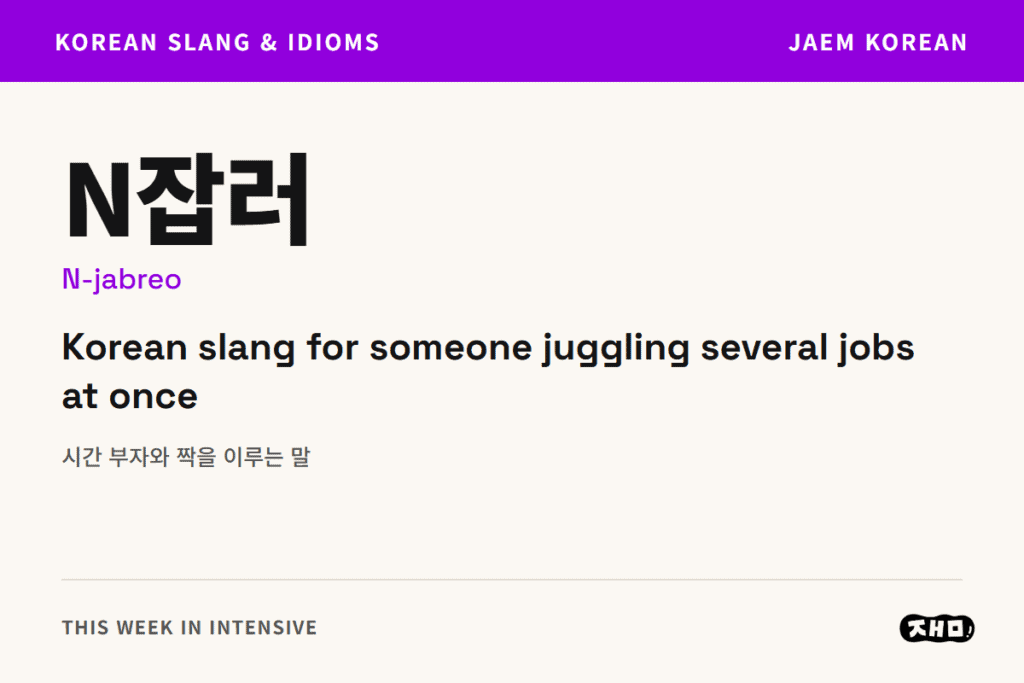
N잡러 means a person who holds several jobs at the same time. The word is built from three pieces — N (the math variable, “some number”), 잡 (the English word работа), and -러 (the English -er, “person who does X”). Koreans use it about themselves with a mix of pride and exhaustion, and its natural opposite, 시간 부자, means someone rich in time rather than money.
You’ll meet the word before any textbook teaches it. A Korean Instagram caption reads “낮에는 회사원, 밤에는 유튜버. 저도 이제 N잡러.” A few posts later, under a photo of a weekday morning coffee, someone writes “퇴사하고 시간 부자 됐어요.” Both sentences use vocabulary you know, and both contain a word your dictionary app doesn’t have.
What N잡러 means, piece by piece
Break the word apart and it explains itself. N is the same N you saw in math class — an unspecified number, as in N개 (some number of things). 잡 is работа, borrowed straight from English. -러 is the borrowed -er suffix that Korean slang attaches freely to make a person-noun.
So an N잡러 is an N-job-er: someone with a plural but unspecified number of jobs. The vagueness is the point. The older word 투잡 (two jobs) locks the number at two and carries a faint smell of financial struggle. N잡러 doesn’t. It appeared in the late 2010s as side work became ordinary for Korean office workers — teaching an evening class, running a smart store, editing video on weekends — and by now it’s the default word, used in news headlines as often as in group chats.
저는 요즘 N잡러예요. — I’m juggling several jobs these days.
N잡러가 되는 게 요즘은 흔한 일이에요. — Becoming a multi-jobber is a common thing these days.
N잡러로 사는 게 쉽지는 않아요. — Living as an N-jobber isn’t easy.
One grammar note that trips students up: N잡러 is a noun, so it takes 이다 endings. Say N잡러예요, never N잡러해요. If you want a verb, use 일을 여러 개 해요 or 부업을 해요.
시간 부자: the opposite Koreans pair it with
시간 부자 literally reads “time rich person.” 부자 is the ordinary noun for a wealthy person, and the slang swaps the currency: this person’s fortune is free time. It’s said with envy and admiration at once, usually about someone who quit a demanding job, chose part-time work, or simply has a schedule that allows a walk on a Tuesday morning. The unspoken second half of the sentence is almost always “even if they don’t have much money.”
퇴사하고 나서 시간 부자가 됐어요. — After quitting, I became time rich.
돈 부자보다 시간 부자가 낫다고 생각해요. — I think being rich in time beats being rich in money.
요즘 시간 부자라서 책을 많이 읽어요. — I’ve got so much free time these days that I read a lot.
The two words define each other. Most people are trading one for the other, and Korean gives you a single noun for each side of the trade.
Two mini dialogues
Dialogue 1 — Catching up with a friend
A: 요즘 왜 이렇게 연락이 안 돼요? — Why have you been so hard to reach lately?
B: 저 요즘 N잡러예요. 평일에는 회사 다니고, 주말에는 카페에서 바리스타 해요. — I’m juggling several jobs these days. Weekdays at the office, weekends as a barista at a café.
A: 와, 몸이 남아나겠어요? — Wow, how is your body holding up?
B: 안 남아나요. 그래도 재미있어요. — It isn’t. But it’s fun.
Dialogue 2 — Two coworkers, one who left
A: 회사 그만두고 어때요? 후회 안 해요? — How is it since you quit? No regrets?
B: 월급은 반으로 줄었는데, 대신 시간 부자가 됐어요. — My income got cut in half, but in exchange I became time rich.
A: 부럽다. 저는 시간이 돈보다 더 없어요. — I’m jealous. I have even less time than money.
B: 그럼 우리가 딱 반대네요. — Then we’re exact opposites.
Similar and opposite expressions
투잡 — “two jobs.” The older, narrower word. Still heard, but N잡러 has largely replaced it because most people now count past two.
부업 — a side job or side business, the neutral standard-Korean term. N잡러 names the person; 부업 names the work. 부업으로 번역을 하고 있어요. — I do translation as a side job.
워라밸 — work-life balance, clipped from the English phrase. A 시간 부자 has good 워라밸; an N잡러 usually doesn’t.
뼈 빠지게 일하다 — to work yourself to the bone. A long-established idiom, not slang. It sits at the N잡러 end of the scale but focuses on exhaustion rather than the number of jobs.
시간에 쫓기다 — to be chased by time, the plain opposite of 시간 부자. 매일 시간에 쫓겨서 밥도 제대로 못 먹어요. — I’m chased by the clock every day and can’t even eat properly.
돈 부자 — money rich. Rarely said alone, but people use it as the deliberate contrast to make the trade-off visible.
When not to use N잡러 or 시간 부자
Both words were born on the internet and they keep that flavor.
Keep N잡러 out of a résumé, a cover letter, or a formal self-introduction. Write 부업을 하고 있습니다 or 여러 일을 병행하고 있습니다 instead. Be careful, too, about calling someone else an N잡러 before they’ve used the word about themselves — for some it’s a proud label, for others it points at financial pressure they’d rather not advertise.
시간 부자 carries its own trap. Because the word contains envy, saying it about another person can sound like you’re noting that they have nothing to do or don’t earn much. It’s safest as a self-description, or as a compliment to a friend who clearly chose their schedule. Avoid it entirely with someone who is out of work against their will.
How we practice this in Intensive
N잡러 and 시간 부자 are the Wednesday expressions of the 10월 A week in our Интенсивный вызов, the week themed “무엇을 하느라 무엇을 못 했나” — what were you doing, and what did you miss because of it. The weekly PDF gives both words with short explanations and a model dialogue, and the Wednesday mission asks a direct question: are you closer to an N잡러 or a 시간 부자 right now, and what have you gained and lost? You answer in writing, then say it out loud in the recorded group class, where we adjust the wording until it sounds like something a Korean friend would actually say. The 1:1 conversation cards keep pushing the same theme, and in your weekly 30-minute 1:1 the teacher fixes your sentences the instant they leave your mouth.
Students remember slang far better when they’ve been made to use it about their own life. A vocabulary card teaches you what N잡러 means; explaining to a teacher that you are one, and what it’s costing you, teaches you how to use it.
Часто задаваемые вопросы
What does N잡러 mean in Korean?
N잡러 means a person who works several jobs at once. It combines N (any number), 잡 (job), and the suffix -러 (-er). It’s casual, internet-born vocabulary, now common enough to appear in news headlines.
Is N잡러 a positive or negative word?
Mostly neutral to positive. People often call themselves N잡러 with some pride, since it suggests energy and multiple skills. It can also hint at financial pressure, so be careful applying it to someone else unless they’ve used it first.
What is the difference between N잡러 and 투잡?
투잡 means exactly two jobs and is the older term. N잡러 leaves the number open — two, three, or more — and names the person rather than the situation. In current speech N잡러 is far more common.
Where to go from here
You’ll pick up words like N잡러 from social media on your own. The hard part is producing them in a live conversation without freezing over the ending. That’s what the Intensive Challenge trains: a weekly PDF, daily missions, a recorded group class, and a 30-minute 1:1 every week with a teacher who corrects you on the spot.
In six weeks, the words come out. And you feel confident using them. See the program at jaem.io/programs/intensive-challenge. Monday’s post covered the grammar from the same week, -느라고 vs -는 대신에 — the pattern every N잡러 uses to explain what they didn’t have time for. Not sure whether Intensive is the right level for you? Join a free lecture first and see how we teach.
Know the grammar, but can’t say it yet?
문법은 아는데 말이 안 나와요?
There is a program for each level and goal. Tell us your level and we’ll point you to one.

About the author
Крис
Chris has taught Korean in Korea for over four years. He teaches TOPIK prep, business Korean, and intermediate to advanced speaking. He is also the head teacher of JAEM.
One Korean tip a week
뉴스레터 · 매주 한 번
A short email with Korean you can use this week. In English, with Korean examples.