In this article
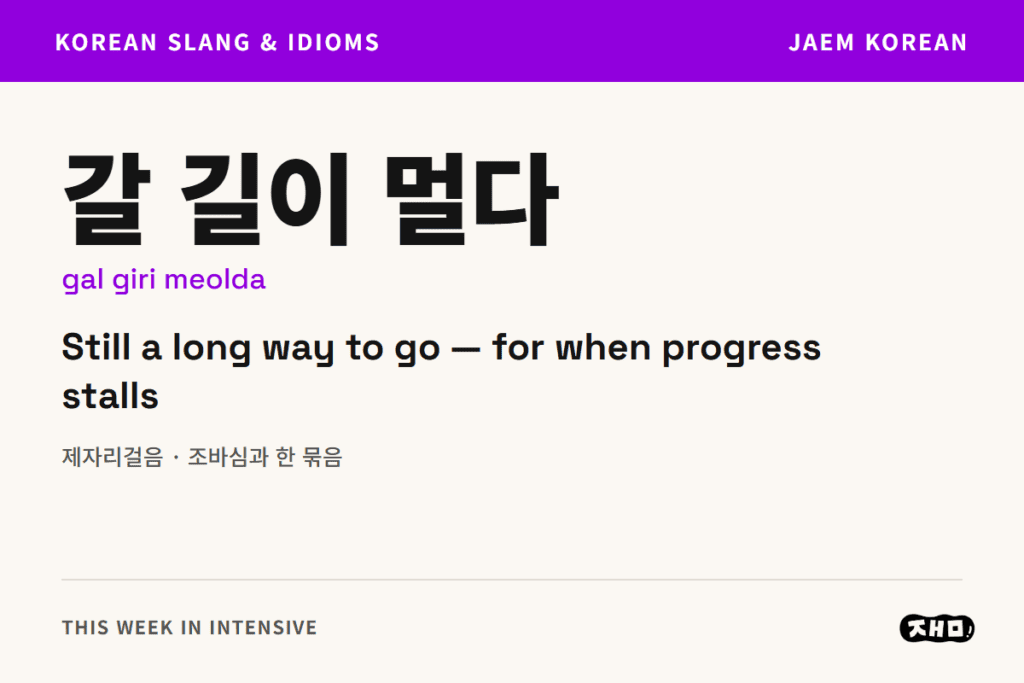
갈 길이 멀다 means “there’s still a long way to go” — literally, “the road to walk is far.” It’s the phrase Koreans use when the goal is real but distant, and it travels with two companions: 제자리걸음, marching in place, and 조바심, the fidgety impatience that shows up when nothing seems to move.
You open your Korean app and the streak reads 240 days. You open your mouth in a café and the sentence still comes out in pieces. That gap between effort and result has its own vocabulary, and this week’s Intensive Challenge material hands students the three most useful pieces of it.
How to say you’re stuck in Korean: 갈 길이 멀다
None of these are slang. Koreans of every age use them about exams, diets, careers, and language learning.
갈 길이 멀다 breaks apart cleanly: 갈 is the future modifier of 가다 (to go), 길 is road, 멀다 is far. The road you still have to walk is long. The idiom comments on a whole situation rather than a single action, which is what separates it from the grammar pattern -(으)려면 멀었다 covered in this week’s grammar post. The grammar needs a verb to attach to; the idiom stands on its own.
아직 갈 길이 멀어요. — There’s still a long way to go.
시작은 좋았는데 갈 길이 머네요. — The start was good, but we’ve got a long road ahead.
한국어는 배우면 배울수록 갈 길이 멀게 느껴져요. — The more Korean I learn, the further the road feels.
Notice the last one. Koreans often use the idiom about their own progress as a way of staying humble, not as a complaint.
제자리걸음 and 조바심: the two words that come with it
제자리걸음 is a compound: 제자리 (one’s own spot) + 걸음 (step). Marching in place. Your legs move, the ground doesn’t. Koreans apply it to any effort that produces no visible movement — a project that only generates meetings, a negotiation that keeps repeating itself, a skill that has stopped improving. It’s a noun, so it appears as 제자리걸음이다 or 제자리걸음을 하다.
말하기 실력이 몇 달째 제자리걸음이에요. — My speaking has been stuck in place for months.
협상이 계속 제자리걸음을 하고 있어요. — The negotiation keeps going nowhere.
조바심 is the anxious, fidgety impatience you feel when things won’t move fast enough. The word is old, and a common folk explanation ties 조 to millet, a grain so small that harvesting it leaves a person restless — treat that as a story rather than a settled etymology. What is certain is the precision of the feeling it names. It isn’t anger and it isn’t fear; it’s the urge to speed up something that can’t be sped up. It pairs with 나다 for the feeling arising and 내다 for acting on it.
결과를 기다리는 동안 조바심이 났어요. — I got antsy while waiting for the result.
조바심 내지 말고 천천히 하세요. — Don’t get impatient; take your time.
Two mini dialogues
Two friends who study Korean together:
A: 요즘 한국어 어때요? 많이 늘었어요? — How is your Korean these days? Improved a lot?
B: 듣기는 좀 나아졌는데 말하기는 완전히 제자리걸음이에요. — Listening got a little better, but speaking is completely stuck.
A: 저도 그랬어요. 갑자기 한 달 뒤에 확 늘더라고요. — I was like that too. Then a month later it suddenly jumped.
B: 그 말 믿고 싶네요. 요즘 조바심이 나서 매일 새 앱만 깔아요. — I want to believe that. I’ve been so impatient I just install a new app every day.
A: 앱을 바꾸는 게 아니라 입을 여는 게 답이에요. — The answer isn’t switching apps. It’s opening your mouth.
At work, a team lead and a new employee:
A: 보고서 진행은 좀 어때요? — How is the report going?
B: 자료는 다 모았는데 아직 갈 길이 멀어요. 정리가 안 돼요. — I have all the data, but there’s still a long way to go. I can’t organize it.
A: 조바심 내지 말고 순서부터 잡아요. 그다음은 빨라요. — Don’t get impatient. Set the order first. After that it moves fast.
B: 네. 어제는 하루 종일 제자리걸음이었거든요. — Okay. Yesterday I spent the whole day getting nowhere.
In both, the listener answers the idiom with advice rather than sympathy. That’s typical: saying 갈 길이 멀어요 in Korean is a small invitation for the other person to help you plan.
Similar and opposite expressions
Near 갈 길이 멀다
- 아직 멀었다 — “still far off.” Shorter, more casual, and the phrase Koreans use to brush off a compliment.
- 산 넘어 산 — “a mountain beyond the mountain,” for when solving one problem reveals the next. More dramatic.
Near 제자리걸음
- 답보 상태 — “a state of standstill.” Formal, common in economic and diplomatic news.
- 정체되다 — to be stagnant. Also used for traffic.
Near 조바심
- 초조하다 — nervous, on edge. Closer to worry than impatience.
- 안달이 나다 — itching to do something. Lighter, a little childish.
Opposites
- 일취월장 — improving by the day and the month, a four-character phrase for fast progress.
- 순조롭다 — going smoothly.
- 느긋하다 — relaxed, unhurried, the mood you want when 조바심 arrives.
When not to use them
Don’t use 갈 길이 멀다 about someone else’s work in front of them. 아직 갈 길이 머네요 after a coworker’s presentation is a judgment, not a comment. Keep it for your own projects, or for a team you belong to.
Don’t use 제자리걸음 for a deliberate pause. If a project is on hold because the client asked for time, that’s 보류 (postponed), not 제자리걸음. The idiom implies effort without result, so using it for a planned break makes your team sound incompetent.
Don’t confuse 조바심 with 조급하다. They overlap, but 조급하다 describes a hasty person or action (조급한 결정, a rushed decision), while 조바심 is the feeling inside. You can feel 조바심 and still act calmly.
And a grammar warning straight from our classroom: 제자리걸음 is a noun. One student spent a week saying 제자리걸음해요 with no particle, which is understandable but sounds unfinished. Use 제자리걸음이에요 for “it’s stuck,” or 제자리걸음을 하고 있어요 for “it has been stuck.”
How we practice this in Intensive
These three come from 9월 Week A of the Intensive Challenge, themed “실력이 느는 속도” — the speed at which skill grows. The whole week is built around the plateau. Monday’s vocabulary, Tuesday’s grammar, Wednesday’s expressions, and Friday’s long reading (an advice-column letter from a new employee who feels stuck) all circle the same experience.
Wednesday’s format is a dialogue plus a written mission: students answer a personal question using the day’s expressions, then talk it through with a teacher. The 1:1 conversation cards at the back of the weekly PDF ask the same kind of thing from a different angle, so by Friday most students have said 제자리걸음 about their own Korean at least three times — roughly the point where it stops being a vocabulary item and becomes a word.
Часто задаваемые вопросы
What does 갈 길이 멀다 mean in Korean?
It means “there’s a long way to go.” Literally the road (길) still to be walked (갈) is far (멀다). Koreans use it about projects, skills, and their own progress, often as a modest way of saying the work isn’t finished.
Is 갈 길이 멀다 negative or positive?
Mostly neutral. It admits work remains without calling it hopeless. Koreans often follow it with 그래도 (still) and something encouraging.
Can 제자리걸음 describe a person?
Indirectly. Say 실력이 제자리걸음이에요 (my skill is at a standstill) rather than 저는 제자리걸음이에요. The thing that isn’t moving is the subject.
Where to go from here
The reason these words matter for learners is that a plateau isn’t a sign you’re failing. It’s a stage, and it ends faster when someone outside your own head can see what’s actually improving.
That’s the job of the Интенсивный вызов: daily missions, a weekly PDF, recorded group classes, and a 30-minute 1:1 every week where your own sentences get corrected on the spot. In six weeks, the words come out. And you feel confident using them.
For the grammar that goes with these idioms — how to answer a compliment when you feel this way — read how to respond to compliments in Korean. If you want a taste of the teaching first, the free lecture is the place to start.
Know the grammar, but can’t say it yet?
문법은 아는데 말이 안 나와요?
There is a program for each level and goal. Tell us your level and we’ll point you to one.

About the author
Крис
Chris has taught Korean in Korea for over four years. He teaches TOPIK prep, business Korean, and intermediate to advanced speaking. He is also the head teacher of JAEM.
One Korean tip a week
뉴스레터 · 매주 한 번
A short email with Korean you can use this week. In English, with Korean examples.