In this article
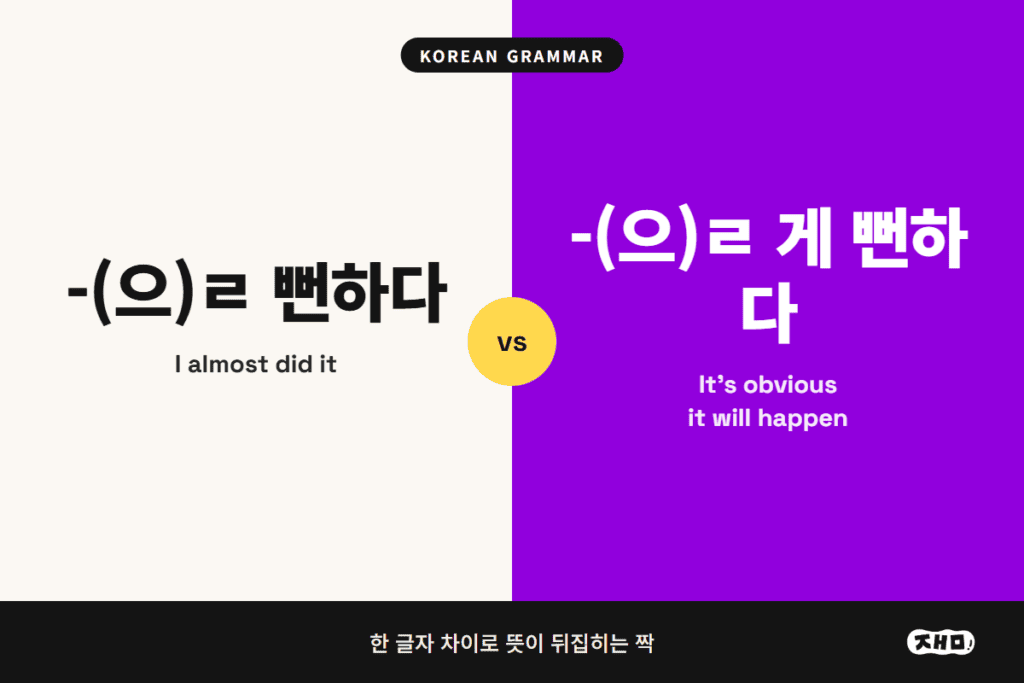
-(으)ㄹ 뻔하다 is the Korean grammar for a near miss: it means “something almost happened but didn’t,” and it is nearly always used in the past tense as -(으)ㄹ 뻔했다. It is a TOPIK II intermediate grammar point. One syllable away sits a completely different pattern, -(으)ㄹ 게 뻔하다, which means “it’s obvious that it will happen.” Same root, opposite job — one looks backward at a disaster you dodged, the other looks forward at an outcome you can already see coming. Here is how to keep them apart, with eight example sentences.
What -(으)ㄹ 뻔하다 means
Attach -(으)ㄹ 뻔하다 to a verb stem and you get “almost did it.” 넘어지다 → 넘어질 뻔했다 (almost fell). 죽다 → 죽을 뻔했다 (almost died). 늦다 → 늦을 뻔했다 (almost was late).
Three facts make the pattern behave:
- It is a past-tense form in practice. The thing did not happen, so it belongs to a moment that has already passed. 넘어질 뻔해요 sounds broken; say 넘어질 뻔했어요.
- The event did not occur. This is the whole point. 지갑을 잃어버릴 뻔했어요 means the wallet is safely in your pocket.
- It takes action verbs, not adjectives. You cannot say 예쁠 뻔했다.
The natural partner adverb is 하마터면 — “very nearly.” 하마터면 넘어질 뻔했어요. Koreans use the two together so often that hearing 하마터면 makes a listener expect 뻔했다 at the end of the sentence.
When Koreans actually use -(으)ㄹ 뻔하다
It is the grammar of the story you tell afterward, with your hand on your chest. Traffic near-misses, a phone almost dropped in the toilet, a train door that closed one second after you got through. The emotional color is relief, and the sentence usually arrives with 천만다행이에요 or 큰일 날 뻔했어요 attached.
It has a second, lighter life as exaggeration. 웃겨서 죽을 뻔했어요 does not describe an actual brush with death — it means “I nearly died laughing.” 배고파서 쓰러질 뻔했어요 works the same way. This hyperbolic use is extremely common in casual speech and is one of the fastest ways to make a story sound Korean rather than translated.
-(으)ㄹ 뻔하다 vs -(으)ㄹ 게 뻔하다
The difference is the 게, and it changes everything.
- -(으)ㄹ 뻔하다 — past, first person, near miss. Something almost happened to you.
- -(으)ㄹ 게 뻔하다 — present or future, third person, confident prediction. Something is obviously going to happen, and you are slightly annoyed or resigned about it.
시험에 떨어질 뻔했어요. — I almost failed the exam. (I passed.)
시험에 떨어질 게 뻔해요. — It’s obvious I’m going to fail the exam. (It hasn’t happened yet, and I already know.)
The second pattern has its own partner adverb: 보나 마나 — “without even looking.” 보나 마나 늦을 게 뻔해요. Where 하마터면 signals relief, 보나 마나 signals a sigh.
This comparison shows up in other grammar guides too, so treat this section as a checklist rather than a discovery: 게 present means prediction, 게 absent means near miss, and the tense on 하다 confirms which one you are hearing.
Eight example sentences
하마터면 지하철에 가방을 두고 내릴 뻔했어요. — I very nearly left my bag on the subway.
계단에서 미끄러져서 크게 다칠 뻔했어요. — I slipped on the stairs and almost got badly hurt.
알람을 못 들어서 면접에 늦을 뻔했어요. — I didn’t hear my alarm and almost showed up late to the interview.
너무 웃겨서 마시던 커피를 뿜을 뻔했어요. — It was so funny I almost spat out the coffee I was drinking.
비밀번호를 세 번 틀려서 계정이 잠길 뻔했어요. — I got the password wrong three times and my account almost got locked.
저 식당은 주말마다 사람이 많으니까 오늘도 기다릴 게 뻔해요. — That restaurant is packed every weekend, so it’s obvious we’ll be waiting today too.
보나 마나 또 늦게 올 게 뻔한데 그냥 먼저 시킬까요? — He’s obviously going to be late again, so should we just order first?
지금 사면 다음 주에 세일할 게 뻔해요. — If we buy it now, it’s a sure thing it’ll go on sale next week.
Common mistakes with -(으)ㄹ 뻔하다
Mistake 1: dropping or adding the 게 by accident. 시험에 떨어질 뻔해요 (present tense, no 게) is the classic broken sentence — it is neither pattern. Decide first: did it nearly happen, or is it obviously coming? Then build the form.
Mistake 2: using -(으)ㄹ 뻔하다 for something that actually happened. If you did fall, say 넘어졌어요. 넘어질 뻔했어요 explicitly means you stayed on your feet, and a Korean listener will hear it that way even if your story continues with a description of your bruises.
Mistake 3: predicting your own behavior with -(으)ㄹ 게 뻔하다. It carries judgment, so aiming it at yourself sounds oddly harsh unless you mean it as self-mockery. For a plain guess about yourself, -(으)ㄹ 것 같아요 is the neutral choice: 늦을 것 같아요.
How we practice -(으)ㄹ 뻔하다 in Intensive
This is the Monday grammar of the 9월 B week in our Intensive Challenge, the “하마터면” week. The weekly PDF puts the two forms on facing pages so the 게 is impossible to miss, and pairs each with its adverb — 하마터면 for close calls, 보나 마나 for predictable outcomes.
The Monday mission asks you to write about a moment last week when something almost went badly, and what you now expect will “obviously” happen next time. You bring those sentences to the recorded group class, where the correction we make most is the missing or extra 게. The week’s 1:1 conversation cards give you prompts about near misses in traffic, at work, and with money, and in your weekly 30-minute 1:1 the teacher corrects each sentence as you say it, not afterward.
FAQ
Is -(으)ㄹ 뻔하다 always used in the past tense?
In practice, yes. The event did not happen, so it belongs to a finished moment: -(으)ㄹ 뻔했어요. You will occasionally see the present form in narration or set phrases, but as a learner you should default to 뻔했어요.
What is the difference between -(으)ㄹ 뻔하다 and 거의?
거의 is an adverb meaning “almost” and can modify many things, including quantities: 거의 다 왔어요. -(으)ㄹ 뻔하다 is a grammar pattern reserved for an event that came close to occurring and then did not. They can appear together: 거의 넘어질 뻔했어요.
Can I use -(으)ㄹ 게 뻔하다 politely?
It is grammatically fine in polite speech, but the meaning carries a note of “of course, what did you expect.” Avoid pointing it at someone senior to you. With friends and about situations rather than people, it is completely normal.
Where to go from here
Near-miss stories are the ones people actually want to tell, which makes -(으)ㄹ 뻔하다 one of the fastest patterns to lock in — once you have said it out loud a few times with someone catching the errors.
That is what the Intensive Challenge gives you: a weekly PDF, daily missions, a recorded group class, and a 30-minute 1:1 every week with live correction. In six weeks, the words come out. And you feel confident using them. See how it works at jaem.io/programs/intensive-challenge. Thursday’s post takes the expression from the same week — 천만다행, the phrase Koreans say the moment a close call is over. New here? Our free lecture is the easiest first step.
Know the grammar, but can’t say it yet?
문법은 아는데 말이 안 나와요?
There is a program for each level and goal. Tell us your level and we’ll point you to one.

About the author
Chris
Chris has taught Korean in Korea for over four years. He teaches TOPIK prep, business Korean, and intermediate to advanced speaking. He is also the head teacher of JAEM.
One Korean tip a week
뉴스레터 · 매주 한 번
A short email with Korean you can use this week. In English, with Korean examples.