In this article
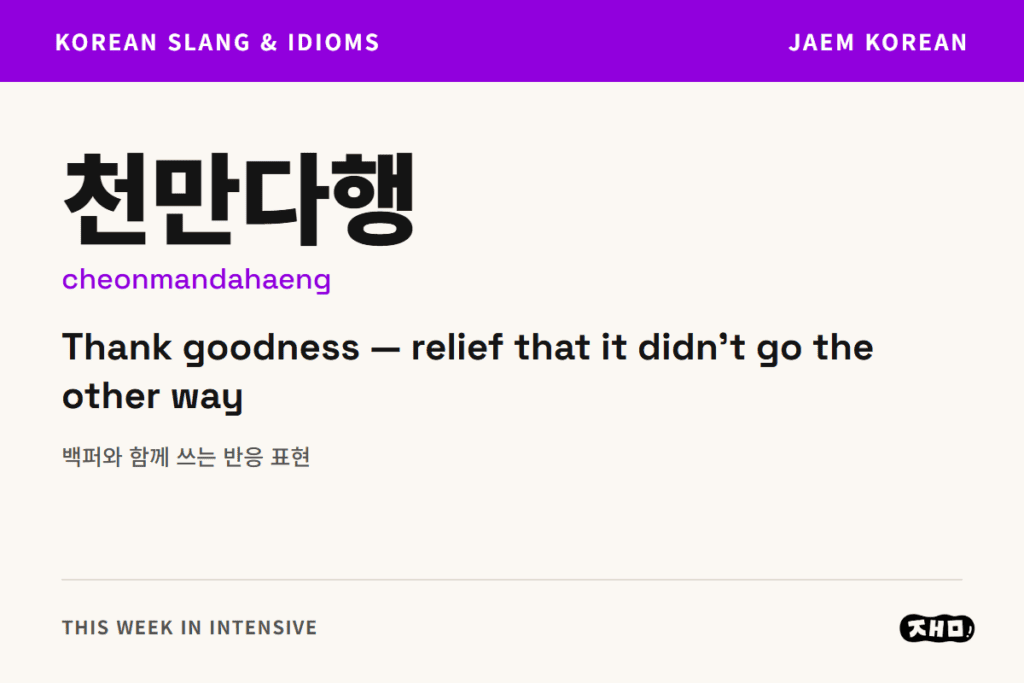
천만다행 means “what a relief” — literally “ten million times fortunate,” the phrase Koreans reach for when something serious almost happened and didn’t. It is the strongest word in a small family of relief expressions, and it pairs in conversation with 백퍼, the slang for being 100 percent certain.
A text arrives: your package is on hold, tap here to fix the address. You’re actually waiting for a delivery, so your thumb is already moving. Then the link looks wrong and you put the phone down. Later a Korean friend says two things: “그거 백퍼 사기야” and “안 눌러서 천만다행이다.”
How Koreans say “thank goodness”
Relief in Korean is a scale, not a single word. Picking the right rung is most of sounding natural.
다행이다 — everyday relief
The plain, all-purpose version: “good thing,” “I’m glad.” Use it for ordinary luck.
비가 안 와서 다행이에요. — It’s a relief it didn’t rain.
늦지 않아서 다행이네요. — Good thing you weren’t late.
천만다행 — ten million times fortunate
천만 means ten million; 다행 means fortunate. Together the Sino-Korean compound (千萬多幸) turns 다행 all the way up. Koreans use it when a genuinely bad outcome was on the table and didn’t arrive: an accident with no injuries, a wallet returned, a scam not clicked. You wouldn’t say it about finding a parking spot; you’d say it about not crashing the car.
It behaves as a noun with 이다 — 천만다행이다, 천만다행이에요, 천만다행이었어요 — and also as an adverb, 천만다행으로.
아무도 안 다쳐서 천만다행이에요. — It’s an enormous relief nobody was hurt.
천만다행으로 지갑을 찾았어요. — Thankfully, I found my wallet.
불이 크게 번지지 않아서 천만다행이었어요. — It was a huge relief the fire didn’t spread far.
불행 중 다행 — the silver lining
For when the bad thing did land, but softly. 차는 망가졌지만 불행 중 다행이에요. — The car is wrecked, but it could have been worse.
백퍼: the slang for “100 percent”
백퍼 is the opposite kind of word: brand-new, casual, short. It’s a clipping of 백 퍼센트 (100 percent), and it means “definitely, for sure, no doubt.” Where 천만다행 reaches back to Chinese characters, 백퍼 comes from text messages and streaming chat, where three syllables beat five.
It works as an adverb or as a one-word answer.
그 얘기 백퍼 사실이에요. — That story is 100 percent true.
주말에는 백퍼 줄이 길어요. — On weekends the line is definitely long.
“갈 거예요?” “백퍼.” — “Are you going?” “Absolutely.”
Two mini dialogues
Dialogue 1 — After a near miss on the road
A: 아까 골목에서 오토바이가 갑자기 튀어나왔어요. 하마터면 부딪힐 뻔했어요. — A motorbike shot out of the alley just now. I almost hit it.
B: 다친 데는 없어요? — You’re not hurt anywhere?
A: 네, 브레이크를 빨리 밟았어요. — No, I hit the brakes in time.
B: 천만다행이네요. 진짜 큰일 날 뻔했어요. — What a relief. That could have been really bad.
Dialogue 2 — Deciding on a restaurant
A: 이 집 진짜 맛있어요? 리뷰가 너무 좋아서 오히려 의심돼요. — Is this place really good? The reviews are so good it makes me suspicious.
B: 백퍼예요. 제가 이번 달에만 세 번 갔어요. — 100%. I’ve been three times this month alone.
A: 그러면 믿어 볼게요. 주말에 줄 길어요? — Then I’ll trust you. Is the line long on weekends?
B: 그건 백퍼 길어요. 평일에 가요. — That’s definitely long. Go on a weekday.
Similar and opposite expressions
Around 천만다행:
큰일 날 뻔했다 — “that could have been a disaster.” Not relief itself, but the sentence that usually sits right beside 천만다행.
휴, 살았다 — “phew, I survived.” Very spoken, very physical.
The opposite direction is 큰일 났다 (we’re in trouble) or 하필 — of all things, why did it have to be that — the word for when luck runs the other way.
Around 백퍼:
확실히 / 분명히 — certainly, definitely. Standard adverbs that fit any register. If you need 백퍼’s meaning in a formal sentence, use one of these.
틀림없이 — without a doubt. Stronger and more written-sounding.
당연하지 — of course. Close in spirit when 백퍼 stands alone as a reply.
The opposite is 글쎄요 (well, I’m not sure) or 반반 (fifty-fifty), the 50% to 백퍼’s 100%.
When not to use them
천만다행 is safe in any setting, formal speech and writing included. Its only failure mode is scale: saying it because the café had oat milk sounds theatrical. Save it for real close calls.
백퍼 is casual speech only. Fine with friends, in group chats, in comments. Not fine in a presentation, an email to a professor, a job interview, or a first meeting with someone’s parents. In those settings use 확실히 or 분명히, or the full 백 퍼센트 if you want the number. With someone senior it can read as flippant, as though you were texting them rather than speaking to them.
One more caution: because 백퍼 claims total certainty, using it when you’re merely fairly sure sets you up. If the restaurant turns out average, “백퍼라면서요” — you said it was 100 percent — is the line you’ll hear.
How we practice this in Intensive
천만다행 and 백퍼 are the Wednesday expressions of the 9월 B week in our Intensive Challenge, the “하마터면” week. The weekly PDF introduces them with a third expression and a model dialogue about a scam text, and the Wednesday mission asks you to write about a close call of your own: what almost happened, why it didn’t, and how sure you are it won’t happen again. You bring that to the recorded group class, where we adjust register on the spot — students routinely drop 백퍼 into an otherwise polite, formal sentence, and hearing why it clashes is faster than reading about it. The week’s 1:1 conversation cards move the theme into speech, and in your weekly 30-minute 1:1 the teacher corrects each sentence the moment you say it.
Relief and certainty are feelings people genuinely want to express, which is why these two get used in real conversation within days of learning them.
FAQ
What does 천만다행 mean in Korean?
천만다행 means “thank goodness” or “what an enormous relief.” 천만 is ten million and 다행 is fortunate, so it reads as “ten-million-times fortunate.” Koreans use it for serious close calls, not for minor luck.
How do you use 천만다행 in a sentence?
Attach 이다: 천만다행이에요, 천만다행이었어요. Or use the adverb 천만다행으로 at the front of the sentence. It usually follows a clause describing what almost went wrong, often one ending in -(으)ㄹ 뻔했다.
Is 백퍼 rude?
Not rude, but casual. It’s slang from text and streaming culture, so it fits with friends and peers. In formal situations or with someone senior, use 확실히, 분명히, or the full 백 퍼센트 instead.
Where to go from here
Words like 천만다행 and 백퍼 are easy to recognize and surprisingly hard to produce at the right register. Knowing that 백퍼 is casual is not the same as having the formal alternative ready when your manager asks. That’s what the Intensive Challenge trains: a weekly PDF, daily missions, a recorded group class, and a 30-minute 1:1 every week where a teacher corrects you as you speak.
In six weeks, the words come out. And you feel confident using them. See the program at jaem.io/programs/intensive-challenge. Monday’s post covered the grammar from the same week, -(으)ㄹ 뻔하다 vs -(으)ㄹ 게 뻔하다 — the “almost happened” pattern that 천만다행 answers. And if you’d like to see how we teach first, our free lecture is the place to start.
Know the grammar, but can’t say it yet?
문법은 아는데 말이 안 나와요?
There is a program for each level and goal. Tell us your level and we’ll point you to one.

About the author
Chris
Chris has taught Korean in Korea for over four years. He teaches TOPIK prep, business Korean, and intermediate to advanced speaking. He is also the head teacher of JAEM.
One Korean tip a week
뉴스레터 · 매주 한 번
A short email with Korean you can use this week. In English, with Korean examples.