In this article
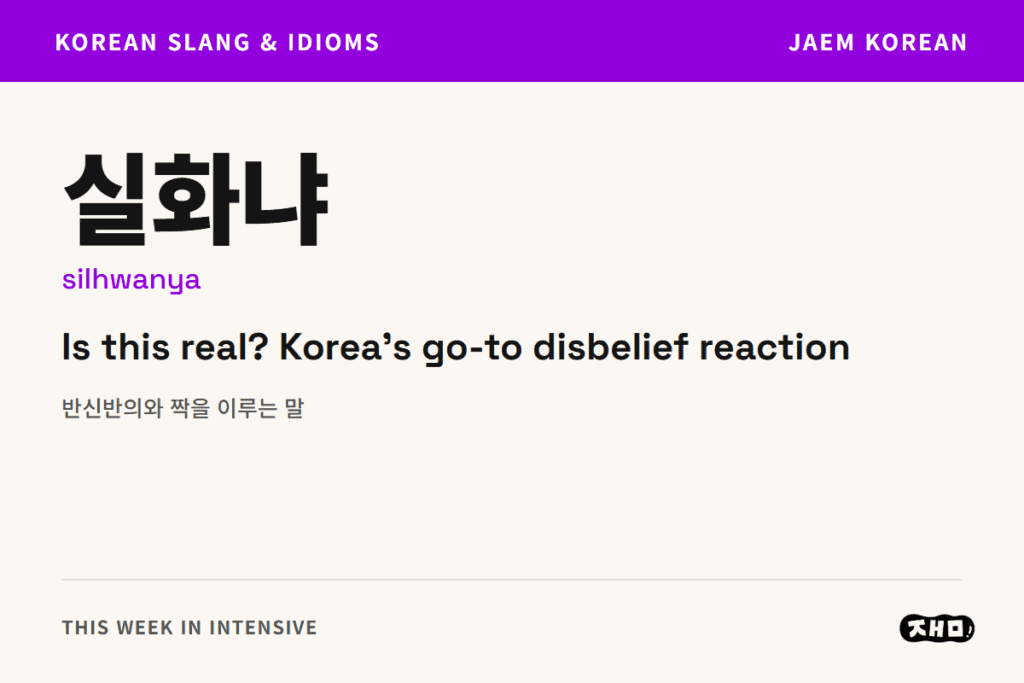
실화냐 (silhwanya) means “Is this a true story?” — used the way English speakers say “Wait, is this for real?” It’s the two-syllable reaction Koreans fire into a group chat when news arrives that’s too surprising to accept immediately. Its calmer cousin, 반신반의, names the state you were in just before: half believing, half doubting.
You’ll meet 실화냐 in comments, memes, and text messages long before any textbook mentions it. Then you’ll wonder why nobody ever explained it.
What 실화냐 means and where it comes from
실화 is not slang at all. It’s the ordinary Sino-Korean noun for a true story — the word printed on a movie poster above “based on a true story” (실화를 바탕으로 한 영화). The slang comes from what got attached to it: -냐, the blunt plain-speech question ending.
So 실화냐 is literally “Is it a true story?” Korean internet culture stripped it of its subject, shortened the situation to the reaction, and turned it into an all-purpose expression of disbelief. Nobody is really asking whether a documentary was made. They’re saying: this cannot be happening.
이거 실화냐? — Is this actually happening?
월요일이 또 왔다고? 실화냐. — Monday came again? You’ve got to be kidding.
실화냐, 진짜 붙었어? — Seriously? You actually got in?
The polite version exists and is perfectly natural: 실화예요? For a formal setting, drop the slang entirely and use 사실인가요? or 정말이에요?
반신반의: the half-believing state before the shock
반신반의 (半信半疑) reads character by character as 반 half, 신 believe, 반 half, 의 doubt — “half believe, half doubt.” Unlike 실화냐, it’s neutral in register and works in conversation, presentations, and writing alike. It’s used as a noun, and much more often as a verb with 하다.
저는 반신반의했어요. — I was only half convinced.
반신반의하면서 신청했어요. — I applied while only half believing it would work.
처음에는 다들 반신반의였어요. — At first everyone was on the fence.
A useful way to place it: 반신반의 is the exact midpoint between 의심하다 (to doubt) and 확신하다 (to be certain).
설마가 사람 잡는다
The proverb that closes the arc is 설마가 사람 잡는다, literally “the ‘surely not’ catches a person.” It’s the warning that the thing you waved off as impossible is exactly what gets you. If 반신반의 is the doubt and 실화냐 is the shock, this proverb is the moral of the story.
Two mini dialogues
Dialogue 1 — At the office, hearing a rumor
A: 팀장님 다음 달에 회사 그만두신대. — I heard the team lead is quitting next month.
B: 진짜? 나는 반신반의야. 지난주에 새 프로젝트 맡으셨잖아. — Really? I’m only half convinced. She just took on a new project last week.
A: 그러니까. 나도 직접 들은 건 아니야. — Exactly. I didn’t hear it from her directly either.
Dialogue 2 — Three days later, in the group chat
A: 방금 전체 메일 왔어. 진짜 그만두신대. — The all-staff email just came. She really is leaving.
B: 실화냐? 설마가 사람 잡는다더니… — Is this real? So the thing we brushed off actually happened.
A: 다음 주에 송별회 한대. — There’s a farewell dinner next week.
Notice how 반신반의 sits inside a sentence like any other verb, while 실화냐 stands alone as a complete reaction. That difference is most of what you need in order to use them naturally.
Similar and opposite expressions
진짜? / 진짜요? — the everyday “really?” Works in every register and carries far less shock than 실화냐.
말도 안 돼 — “that makes no sense,” for when the reaction is flat disbelief rather than surprise.
대박 — the all-purpose “wow,” positive or negative. Often follows 실화냐 in the same message.
긴가민가하다 — to be unsure, “is it or isn’t it.” More colloquial than 반신반의, same fuzziness. 아직도 긴가민가해요. — I’m still not sure.
확신이 안 서다 — literally “conviction doesn’t stand.” Slightly more formal; good in writing.
확신하다 — to be certain, the opposite pole. 저는 확신해요. — I’m sure of it.
When not to use these expressions
Don’t use 실화냐 upward. The -냐 ending is plain speech, for close friends or people younger than you. Saying it to a manager, a client, or a teacher lands badly even as a joke. Switch to 실화예요?, or in a properly formal setting, 사실인가요?
Don’t use 실화냐 for small surprises. It signals “this is hard to believe.” If someone tells you the cafe changed its menu, 실화냐 sounds theatrical. Save it for news that genuinely makes you sit up.
Don’t use 반신반의 when you actually lean one way. It means roughly fifty-fifty. If you’re eighty percent sure, say 거의 믿어요 or 아마 맞을 거예요. Students reach for 반신반의 because it sounds sophisticated — and it does — but a Korean listener takes it literally.
How we practice this in Intensive
실화냐 comes from April Week B, where the topic is reacting to surprising news and spotting what’s fake. 반신반의 anchors the July Week B expression lesson, whose theme is roughly “underestimating someone and getting a plot twist.” The weekly PDF introduces the expressions in story order — half-doubting, dismissing, then the proverb about the dismissed thing happening — so the vocabulary follows the emotional arc rather than a random list.
The Wednesday mission for both weeks asks students to write a short dialogue using the day’s expressions and bring it to the recorded group class. That’s where register problems get caught: someone writes 실화냐 in a conversation with their boss, and we fix it together. The 1:1 dialogue cards give the teacher a reason to spring surprising news on you during the weekly 30-minute session, so you react in real time and hear whether your 실화냐 sounded natural or stiff.
That live correction is what makes the difference. In six weeks, the words come out. And you feel confident using them.
FAQ
What does 실화냐 mean in Korean?
실화냐 means “Is this a true story?” and functions as a slang reaction meaning “Is this for real?” It combines 실화 (true story) with the plain-speech question ending -냐. It’s casual, so use 실화예요? with people you’d address politely.
What’s the difference between 실화냐 and 진짜?
진짜 is the everyday “really?” and carries no strong emotion. 실화냐 adds shock and a hint of humor, and its -냐 ending is plain speech, so it belongs to close friends and online comments only.
Is 반신반의 formal or casual?
Both. It’s a standard Sino-Korean idiom, so it works in conversation, presentations, and written Korean. Only the verb ending changes: 반신반의해 with friends, 반신반의해요 or 반신반의합니다 in polite settings.
Where to go from here
These are reaction words, and reactions only become natural once you’ve used them in a real exchange and had someone tell you the tone was off. That’s hard to get from a vocabulary list.
The Intensive Challenge is built around exactly that kind of practice: six weeks of weekly PDFs, daily missions, recorded group classes, and a 30-minute 1:1 every week where your sentences get corrected as you say them. The grammar post from the same week covers how Koreans voice a guess before they’re sure: -나 보다 vs -나 싶다. If you’d like to see how a class runs first, try the free lecture.
Know the grammar, but can’t say it yet?
문법은 아는데 말이 안 나와요?
There is a program for each level and goal. Tell us your level and we’ll point you to one.

About the author
Chris
Chris has taught Korean in Korea for over four years. He teaches TOPIK prep, business Korean, and intermediate to advanced speaking. He is also the head teacher of JAEM.
One Korean tip a week
뉴스레터 · 매주 한 번
A short email with Korean you can use this week. In English, with Korean examples.