In this article
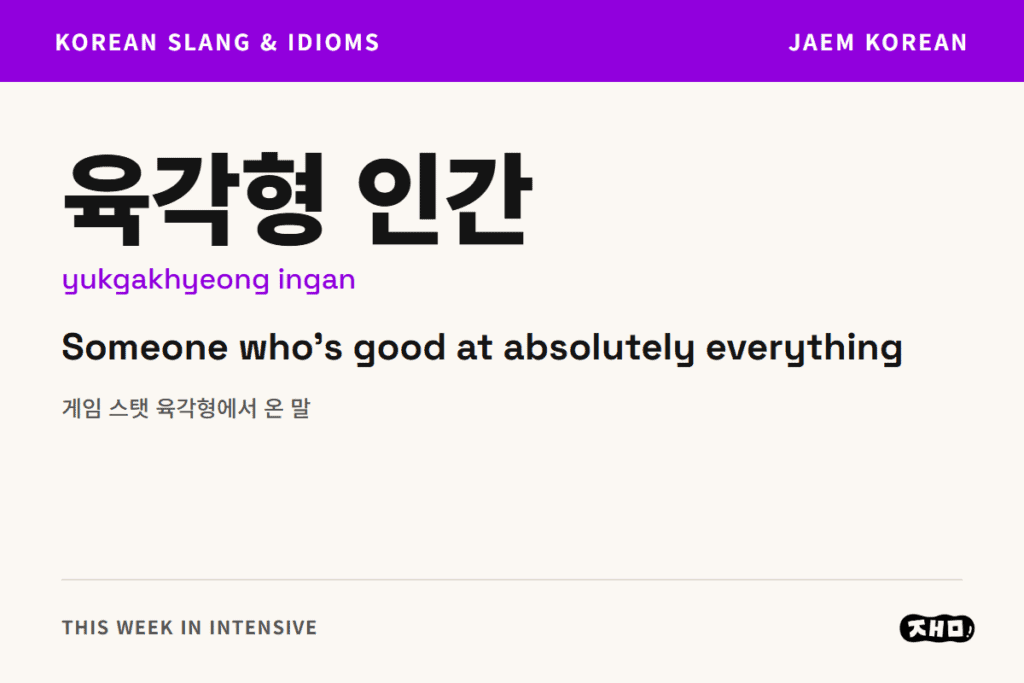
육각형 인간 (yukgakhyeong ingan) means a “hexagon person” — someone whose looks, brains, personality, fitness, taste, and career are all high at once. Korean borrowed the image straight from video games, and it comes with two companions: 사기캐, the joke version, and 다재다능, the formal one.
Someone on your team speaks three languages, runs marathons, cooks, and somehow also has time to be nice. English reaches for “overachiever,” which sounds faintly like an insult. Korean has a gentler, funnier set of words for that person.
What 육각형 인간 means, and the game stat behind it
In most role-playing and sports games, a character’s abilities are drawn as a radar chart with six axes — attack, defence, speed, and so on. Max out every stat and the shape becomes a large, perfectly balanced hexagon. Leave one weak and the shape caves in on that side.
That picture is the whole word. A 육각형 인간 is a person whose chart has no dent in it. The term was popularised as a Korean consumer-trend keyword in the mid-2020s and spread into ordinary speech and news columns alike, where it now often describes the impossible standard young Koreans feel pressured to meet.
저 사람 완전 육각형 인간이야. — That person is a total all-rounder.
요즘은 다들 육각형 인간이 되고 싶어 해요. — These days everyone wants to be an all-rounder.
육각형 인간은 현실에 없어요. — The perfectly balanced person doesn’t exist in real life.
It’s a compliment with a shrug inside it: “they seem to have it all.”
사기캐: the joke version, also from gaming
사기캐 is a clipping of 사기 캐릭터, literally “fraud character.” In games it means a character so overpowered that it breaks the balance and feels like cheating. Applied to a real person, it’s playful — this person is so good it’s unfair. You’ll hear it about idols, athletes, and the new hire everyone is slightly intimidated by.
얘 진짜 사기캐야. — This guy is straight-up overpowered.
노래도 잘하고 춤도 잘 춰? 사기캐네. — Sings well and dances well? That’s an OP character.
The older cousin is 엄친아 — “my mom’s friend’s son,” the mythical perfect kid every Korean parent compared you to.
다재다능: the word for interviews
다재다능 (多才多能) is the dictionary term: “many talents, many abilities.” It’s a neutral Sino-Korean four-character word, and the one to use in an interview, a recommendation letter, or an article. It appears as an adjective, 다재다능하다, or as a modifier, 다재다능한 사람.
그분은 정말 다재다능하세요. — She really is multi-talented.
다재다능한 사람을 찾고 있습니다. — We’re looking for someone with a broad skill set.
Two mini dialogues
Dialogue 1 — At a friend’s housewarming
A: 저 사람 누구야? 요리도 직접 다 했대. — Who’s that? I heard he cooked everything himself.
B: 민준 씨. 회사에서도 잘나가고 마라톤도 뛰어. — That’s Minjun. He’s doing well at work and runs marathons too.
A: 얼굴도 저렇게 생겼는데? 완전 육각형 인간이네. — And he looks like that? He’s a total hexagon person.
B: 그러니까. 좀 반칙이지. — Right? Kind of unfair.
Dialogue 2 — Watching a variety show
A: 이 아이돌 노래도 하고 작곡도 하고 예능도 잘하네. — This idol sings, composes, and is good on variety shows too.
B: 사기캐야, 사기캐. 게임이면 밸런스 패치 들어갔어. — That’s an OP character. If this were a game they’d have patched him by now.
A: 인터뷰에서는 다재다능하다고 하던데, 그게 점잖은 표현이었구나. — The interview called him “multi-talented.” So that was the polite version.
The second dialogue puts all three on one scale: 사기캐 for the joke between friends, 다재다능 for what the interviewer said on air.
Similar and opposite expressions
엄친아 / 엄친딸 — “mom’s friend’s son/daughter,” the perfect peer you were measured against. Older slang, slightly bitter.
만능 — all-purpose, all-round. 만능 엔터테이너 — an all-round entertainer.
팔방미인 — “a beauty on all eight sides,” an older idiom for someone good at everything. Formal enough for writing.
인간 승리 — “human victory,” for someone who got there through effort rather than raw talent.
한 우물만 파다 — “to dig only one well,” to specialise deeply in one thing. The opposite approach, and praise in its own right.
이것도 저것도 아니다 — “neither this nor that,” the jack of all trades who masters none.
When not to use these words
Don’t use 사기캐 about someone senior or in formal writing. It’s gaming slang with the word “fraud” inside it. Between friends it’s a joke; in an email about your director it reads as mocking or simply bizarre. Use 다재다능하시다 or 능력이 뛰어나시다.
Be careful with 육각형 인간 to someone’s face. Because the word now carries the sense of an unrealistic standard, some Koreans hear it as pressure rather than praise. Among friends it lands fine. Said to a stranger, it can sound like you’re sizing them up.
Don’t use 다재다능 for a single skill. It means many talents. Someone brilliant only at piano is 피아노 실력이 뛰어나다, not 다재다능하다.
Don’t call yourself a 육각형 인간. Even as a joke it reads as bragging. Koreans will happily say it about you, and the right response is 아니에요, 아직 멀었어요.
How we practice this in Intensive
June Week A is the “multi-talented people” week. The weekly PDF introduces 육각형 인간 first with its gaming origin, then 사기캐 and its cousin 엄친아, then 다재다능 as the formal register, so the three sit on a scale from meme to dictionary. Each expression comes with a short Korean explanation, an English one, and a three-line exchange, and then all of them appear in a longer dialogue about watching an old idol interview and realising the person was a 사기캐 all along.
The Wednesday mission asks students to describe someone they know using at least one of the three, and to pick the register that fits who’s listening. In the recorded group class we read those aloud, and the most common fix is the student who used 사기캐 about their professor. The weekly 30-minute 1:1 uses dialogue cards built around admiring someone, which is where the week’s grammar and 육각형 인간 land in the same breath and start to sound natural.
In six weeks, the words come out. And you feel confident using them.
FAQ
What does 육각형 인간 mean in Korean?
육각형 인간 means “hexagon person” — someone strong in every area at once. The image comes from game stat charts, where six maxed-out abilities draw a full hexagon. It’s a compliment, though it often carries a note of unrealistic expectation.
Is 육각형 인간 a compliment?
Usually yes, but read the room. The word has a second life in news and social commentary as the impossible standard people feel pressured to meet, so it can land as pressure rather than praise with someone you don’t know well.
What’s the difference between 사기캐 and 엄친아?
Both mean “unfairly perfect person.” 사기캐 comes from gaming — an overpowered character — and applies to anyone, including celebrities. 엄친아 comes from “my mom’s friend’s son,” so it’s specifically about a peer you’re being measured against.
Where to go from here
The interesting part of these words isn’t the meaning, which you can look up, but the register: knowing that 사기캐 belongs in the group chat and 다재다능 belongs in the interview. That judgment comes from hearing yourself use the wrong one and being corrected on the spot.
The Intensive Challenge is built for that: six weeks of weekly PDFs, daily missions, recorded group classes, and a 30-minute 1:1 every week with live correction. The grammar post from the same week covers 밖에 and how Korean says “only”. If you want to try a class before committing, the free lecture is the place to start.
Know the grammar, but can’t say it yet?
문법은 아는데 말이 안 나와요?
There is a program for each level and goal. Tell us your level and we’ll point you to one.

About the author
Chris
Chris has taught Korean in Korea for over four years. He teaches TOPIK prep, business Korean, and intermediate to advanced speaking. He is also the head teacher of JAEM.
One Korean tip a week
뉴스레터 · 매주 한 번
A short email with Korean you can use this week. In English, with Korean examples.