In this article
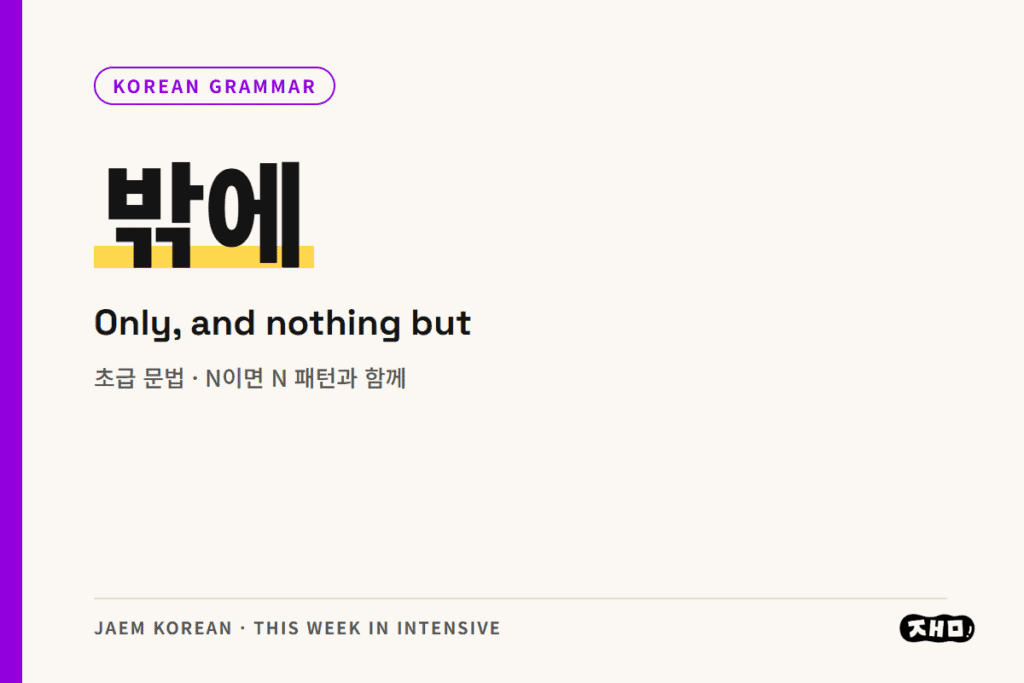
밖에 is the Korean particle that means “only” or “nothing but” — and unlike English “only,” it always has to be followed by a negative: 없다, 안, 못, or 모르다. 물밖에 없어요 means “there’s nothing but water.” 한국어밖에 못 해요 means “I can only speak Korean.” It is a beginner grammar point on the official TOPIK list, which makes the mistakes below all the more worth fixing early, because they follow learners for years.
This post covers what 밖에 does, why it feels different from the neutral 만, nine example sentences, the three slips we correct most in class, and a bonus pattern from the same Intensive week that pulls in the opposite direction: N이면 N, the way Koreans praise someone who’s good at everything.
What 밖에 means
밖에 attaches directly to a noun — no spacing, no separate particle — and excludes everything else. Literally it comes from 밖 (“outside”): “outside of N, nothing.”
The grammar rule is short and absolute: the verb that follows must be negative.
- 물밖에 없어요 — there’s nothing but water
- 커피를 한 잔밖에 안 마셨어요 — I only drank one cup of coffee
- 이 노래밖에 몰라요 — this is the only song I know
- 십 분밖에 못 기다려요 — I can only wait ten minutes
If the negative feels awkward in a sentence you’re building, that’s your signal that 밖에 is the wrong particle for it.
And 밖에 is the emotional “only.” Where English “only” is neutral, 밖에 carries a feeling: not enough, disappointing — or, flipped positive, “you’re the only one who matters.”
시간이 십 분밖에 없어요 sounds like a complaint. 나한테는 너밖에 없어 is a declaration of love. Same particle, opposite mood, both built on the same sense that everything else has been excluded.
Koreans also use it in questions to show frustration: 이것밖에 못 해? (“this is all you can do?”). That one lands hard, so use it carefully.
밖에 vs 만: the comparison that matters
만 also means “only,” and this is the split our materials spend the most time on.
| N만 | N밖에 | |
|---|---|---|
| Verb that follows | positive or negative | negative only |
| Feeling | neutral, factual | limited, disappointed, or emotionally emphatic |
| Example | 물만 마셨어요. — I drank only water. (a fact) | 물밖에 안 마셨어요. — All I drank was water. (and it wasn’t enough) |
A useful test: if you could add “and that’s fine” to the end of the sentence, use 만. If you’d add “unfortunately” or “and no one else,” use 밖에.
Nine example sentences
지갑에 천 원밖에 없어서 버스를 못 탔어요. — I only had a thousand won in my wallet, so I couldn’t take the bus.
저는 한국 노래 중에 이 곡밖에 몰라요. — Of Korean songs, this is the only one I know.
이 문제는 선생님밖에 못 풀 것 같아요. — I think only the teacher can solve this problem.
하루에 커피를 한 잔밖에 안 마시는데 왜 잠이 안 올까요? — I only drink one coffee a day, so why can’t I sleep?
결국 힘들 때 곁에 있어 주는 사람은 가족밖에 없더라고요. — In the end, the only people who stay beside you when it’s hard are family.
시험까지 이틀밖에 안 남았어요. — There are only two days left until the exam.
냉장고에 계란밖에 없어서 계란밥을 만들었어요. — There was nothing but eggs in the fridge, so I made egg rice.
우리 팀장님은 기획이면 기획, 발표면 발표 다 잘하세요. — Our team lead is good at everything, planning and presenting alike.
동생은 게임이면 게임, 요리면 요리 못하는 게 없어요. — My younger brother can do anything, from games to cooking.
Common mistakes with 밖에
Mistake 1: pairing 밖에 with a positive verb. 물밖에 마셨어요 is the single most common error we see. It has to be 물밖에 안 마셨어요 or 물밖에 못 마셨어요. If the negative feels wrong, switch particles: 물만 마셨어요.
Mistake 2: using 밖에 when you mean a neutral “only.” “I only study on weekends,” as a plain fact, is 주말에만 공부해요. Say 주말밖에 공부 못 해요 and a Korean listener hears “I can’t find time except weekends, sadly.” Sometimes that’s exactly what you mean. Often it isn’t.
Mistake 3: adding 은/는/이/가 around it. 밖에 replaces the subject and object particles rather than stacking with them. It’s 시간이 십 분밖에 없어요, not 십 분밖에가 없어요, and 저밖에 없어요, not 저는밖에 없어요.
Bonus pattern: N이면 N, the opposite of 밖에
The same Intensive week teaches a pattern that sits at the far end of the same scale. N이면 N, N이면 N lists two areas (occasionally three) and says the person excels at all of them: 공부면 공부, 운동이면 운동. The structure is noun + 이면 + the same noun, repeated; after a vowel, 이면 shortens to 면. The sentence usually closes with 다 잘하다 or 못하는 게 없다, though the rhythm alone already carries the praise.
It doesn’t have to be about people: 이 카페는 커피면 커피, 디저트면 디저트 다 맛있어요 works fine. The point is completeness across categories, and the bouncy repetition keeps it firmly in spoken Korean.
One trap: the same noun has to appear on both sides of 이면. 공부면 운동이면 다 잘해요 doesn’t work — the echo is the grammar.
Where 밖에 narrows down to one thing, N이면 N opens up to everything. Students who learn the two side by side rarely confuse either with 만 afterward, because the contrast is so sharp.
How we practice this in Intensive
This is the “good at everything” week of our Intensive Challenge. The weekly PDF introduces 밖에 first, with a short contrast against 만 and a note on its emotional weight, then N이면 N as the opposite pole. The pattern drills split 밖에 into two uses so you feel the range: 밖에 in frustrated questions, then 밖에 in warm, positive statements.
For the Tuesday mission, students write three sentences of their own. In the recorded group class the teacher reads them back and asks, for every 밖에, “did you mean neutral only, or unhappy only?” That single question catches nearly all the 만/밖에 mix-ups. The weekly 30-minute 1:1 uses dialogue cards where you describe someone you admire, so N이면 N comes out in real conversation with the rhythm corrected on the spot.
FAQ
Can 밖에 be used with a positive verb in Korean grammar?
No. 밖에 always needs a negative: 없다, 안, 못, or 모르다. For “only” with a positive verb, use 만 instead. 커피만 마셔요 is fine; 커피밖에 마셔요 is not.
What is the difference between 밖에 and 만?
만 is neutral and works with any verb. 밖에 requires a negative and adds a feeling — usually that the amount is too small, sometimes that nothing else matters. Same English translation, different emotional load.
How many nouns can N이면 N list?
Usually two, sometimes three. Beyond that the rhythm breaks down. Two well-chosen contrasts plus 다 잘해요 already carry the meaning.
Where to go from here
The 만/밖에 distinction is one of the clearest cases of Korean grammar carrying emotion, and it stays theoretical until somebody asks you, sentence by sentence, “which one did you mean?”
In six weeks, the words come out. And you feel confident using them — see how the program works at jaem.io/programs/intensive-challenge. Thursday’s post covers the slang for the person who’s good at everything, 육각형 인간, which is the vocabulary version of N이면 N. And if you’d like to see the teaching style before enrolling, the free lecture is a good place to begin.
Know the grammar, but can’t say it yet?
문법은 아는데 말이 안 나와요?
There is a program for each level and goal. Tell us your level and we’ll point you to one.

About the author
Chris
Chris has taught Korean in Korea for over four years. He teaches TOPIK prep, business Korean, and intermediate to advanced speaking. He is also the head teacher of JAEM.
One Korean tip a week
뉴스레터 · 매주 한 번
A short email with Korean you can use this week. In English, with Korean examples.