In this article
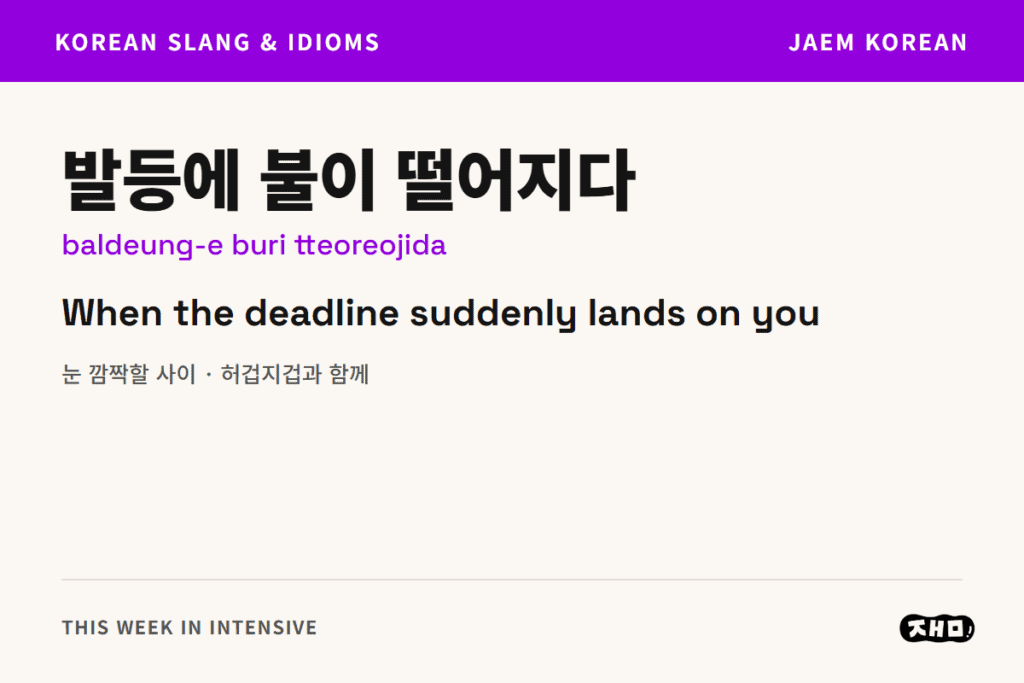
발등에 불이 떨어지다 (baldeung-e buri tteoreojida) means that something has suddenly become urgent — literally, “fire has landed on the top of your foot.” It is the idiom Koreans reach for when a deadline they’d been ignoring arrives all at once, and it’s the anchor of a small family of expressions for rushing.
It’s 5:30 on a Friday. Your manager says the report she mentioned last week is due at 6:00, not Monday. You have thirty minutes. Every office in Seoul has a phrase for that, and this is it.
How Koreans talk about being in a rush
Korean splits the experience of a rushed day into three separate pieces, and each has its own expression. There’s the moment something becomes urgent — that’s 발등에 불이 떨어지다. There’s the way the time then vanishes — 눈 깜짝할 사이. And there’s how you look while it’s happening — 허겁지겁.
Pick the wrong one and the sentence still makes sense, but it answers a question nobody asked. So it helps to learn them as three angles on one bad Tuesday rather than three synonyms.
발등에 불이 떨어지다: the moment it becomes urgent
The idiom breaks down as 발등 (the top of the foot) + 불 (fire) + 떨어지다 (to fall onto). If a burning ember lands on your foot, you don’t put it on the calendar. You react now.
It almost always appears in the past tense, because by the time you say it, the fire has already landed.
이제 진짜 발등에 불이 떨어졌어요. — Now it’s genuinely urgent.
발등에 불이 떨어져야 시작해요. — I only start once the deadline is on fire.
발등에 불 떨어지기 전에 미리 하세요. — Do it in advance, before the fire lands.
Note the third one: in casual speech the 이 after 불 often drops.
눈 깜짝할 사이: how fast the time went
눈 (eye) + 깜짝하다 (to blink) + 사이 (interval): “in the blink of an eye.” It describes a stretch of time that felt impossibly short, and it usually carries the particle 에.
주말이 눈 깜짝할 사이에 지나갔어요. — The weekend went by in a blink.
눈 깜짝할 사이에 다 팔렸어요. — It sold out in an instant.
아이들이 눈 깜짝할 사이에 컸어요. — The kids grew up before I knew it.
허겁지겁: how you look while scrambling
허겁지겁 is a mimetic adverb, one of the hundreds of sound-and-motion words Korean uses. It describes doing something in a flustered, hurried way — eating, running, packing. There’s no origin story; the word simply sounds like scrambling. It sits directly in front of the verb.
허겁지겁 밥을 먹었어요. — I wolfed down my food.
늦잠 자서 허겁지겁 나왔어요. — I overslept, so I rushed out.
허겁지겁 가방을 챙겼어요. — I threw my things into my bag in a panic.
Two mini dialogues
Dialogue 1 — The presentation
지은: 다음 주 발표 준비 다 했어? — Have you finished preparing next week’s presentation?
민수: 다음 주? 내일 아니었어? — Next week? Wasn’t it tomorrow?
지은: 아니, 내일로 바뀌었어. 방금 메일 왔잖아. — No, it got moved to tomorrow. The email just came, remember?
민수: 뭐? 이제 진짜 발등에 불이 떨어졌네. 오늘 밤 새워야겠다. — What? Now the fire’s really on my foot. I’ll have to pull an all-nighter.
Dialogue 2 — The morning after
하나: 어제 몇 시에 잤어? 얼굴이 왜 그래? — What time did you sleep last night? Why does your face look like that?
준호: 새벽 세 시. 그리고 아침에 늦잠 자서 허겁지겁 뛰어왔어. — Three a.m. And I overslept, so I came running in a panic.
하나: 그래도 발표는 잘 끝났잖아. — Still, the presentation went well.
준호: 응, 근데 십 분이 눈 깜짝할 사이에 지나가서 뒷부분은 기억도 안 나. — Yeah, but the ten minutes went by in a blink and I don’t even remember the second half.
Similar and opposite expressions
급하다 — the plain adjective for “urgent.” Use it when you need the meaning without the color: 급한 일이 생겼어요. — Something urgent came up.
코앞이다 — “right in front of your nose,” said of a deadline that’s almost here. 시험이 코앞이에요. — The exam is right around the corner. Less panicked than 발등에 불.
순식간에 — “in an instant,” the Sino-Korean cousin of 눈 깜짝할 사이에. Interchangeable in most sentences; 순식간에 is slightly more formal.
부랴부랴 — another mimetic adverb for rushing, very close to 허겁지겁. If there’s a difference, 부랴부랴 is about hurrying to get somewhere, while 허겁지겁 leans toward eating and physical scrambling.
느긋하다 — the opposite of all three: relaxed, unhurried. 주말에는 느긋하게 보내고 싶어요. — I want to take it easy on the weekend.
미리미리 — “well in advance,” the habit that prevents 발등에 불 from ever happening. Korean parents and teachers say it constantly.
When not to use these expressions
발등에 불이 떨어지다 is for deadlines, not emergencies. A report, an exam, a rent payment: yes. A medical emergency or an accident: no. The idiom carries a slightly comic, self-inflicted feeling — “I should have started earlier.” Using it for something genuinely serious sounds flippant.
눈 깜짝할 사이 is for time that felt short, not time that was short. Two seconds is not 눈 깜짝할 사이; it’s just two seconds. The expression is about perception, so it pairs with things that should have taken longer: a vacation, a year, a childhood.
허겁지겁 describes someone else, or your past self. It carries a hint of looking undignified. Saying 허겁지겁 먹었어요 about your own breakfast is fine and even funny. Describing your boss’s lunch that way, to your boss, is not.
How we practice this in Intensive
All three expressions come from the Wednesday expression pages of March Week B. In the weekly PDF each gets a one-line definition in Korean and English, then a single example, and then all three are dropped together into a dialogue about a workplace where the manager keeps changing his mind. You read the dialogue, listen to the audio, and answer a short quiz that checks whether you caught which expression went where.
That dialogue is the model for the week’s speaking task: describe your own most rushed recent day using at least two of the three. In the recorded group class, the teacher listens for the particle after 눈 깜짝할 사이 and the placement of 허겁지겁 — the two things students most often get slightly wrong — and corrects them on the spot. The weekly 30-minute 1:1 gives the story a second pass, this time at conversational speed.
Preguntas frecuentes
What does 발등에 불이 떨어지다 mean in Korean?
It means a situation has suddenly become urgent, usually a deadline you’d been putting off. Literally “fire has fallen on the top of your foot.” It’s normally used in the past tense: 발등에 불이 떨어졌어요.
Is 발등에 불이 떨어지다 formal enough for the office?
Yes. It’s an idiom, not slang, and it’s used freely in workplace conversation and even in news headlines about policy deadlines. It would be out of place only in a very formal written report.
What’s the difference between 눈 깜짝할 사이에 and 금방?
금방 means “soon” or “quickly” and is neutral. 눈 깜짝할 사이에 emphasizes that the time felt shockingly short. 금방 끝났어요 is “it ended quickly.” 눈 깜짝할 사이에 끝났어요 is “it was over before I knew it.”
Where to go from here
This week’s grammar post, -자마자 and -아/어 버리다, gives you the endings that go with these idioms, so you can say what you did the moment the fire landed.
You can memorize 발등에 불이 떨어지다 in a minute. Using it in a story about your own week, with the right particle and the right tense, while a teacher listens and fixes what came out wrong, is what Desafío intensivo is built for: six weeks of weekly PDFs, daily missions, recorded group classes, and a 30-minute 1:1 every week with correction as you speak. In six weeks, the words come out. And you feel confident using them.
If you’d rather hear a class before you decide, start with a free lecture.
Know the grammar, but can’t say it yet?
문법은 아는데 말이 안 나와요?
There is a program for each level and goal. Tell us your level and we’ll point you to one.

About the author
Chris
Chris has taught Korean in Korea for over four years. He teaches TOPIK prep, business Korean, and intermediate to advanced speaking. He is also the head teacher of JAEM.
One Korean tip a week
뉴스레터 · 매주 한 번
A short email with Korean you can use this week. In English, with Korean examples.