In this article
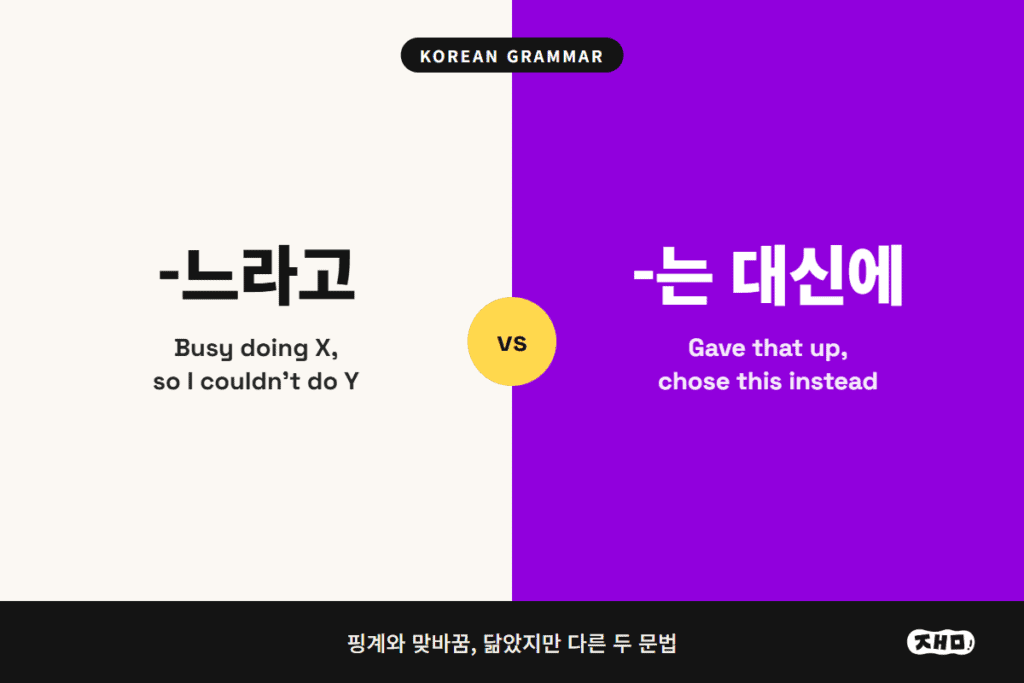
-느라고 is the Korean connector that means “because I was busy doing X, I couldn’t do Y” — it attaches to an action verb and marks that verb as the reason something else failed to happen. It is a TOPIK II intermediate grammar point, and it is what you reach for when someone asks why you didn’t reply, why you’re late, or why you skipped lunch. Its partner in this article, -는 대신에 (“instead of, in exchange for”), covers the trade you made on purpose. This post takes both apart side by side, with eight fresh examples and the mistakes learners make most.
What -느라고 means
-느라고 attaches to an action verb stem: 하다 → 하느라고, 먹다 → 먹느라고, 준비하다 → 준비하느라고. In speech the final 고 often drops — 하느라, 먹느라 — and both forms are correct.
The clause that follows is almost always something you couldn’t do, didn’t do, or something that went wrong. Time and energy went into the first action, and the second action paid for it.
Two conditions come with the pattern, and they are worth memorizing as a pair:
- The person doing the first action and the person who suffers the result must be the same person. “I was studying, so my friend got bored” does not work with -느라고.
- The first verb has to be an activity, not a state. 피곤하느라고 is impossible, because being tired is not something you do.
When Koreans actually use -느라고
In real conversation, -느라고 is the grammar of the apology. It shows up when you’re late, when you missed a call, when you didn’t sleep. The tone is “I had a reason, and the reason took everything I had.”
Notice what kind of second clause it prefers. Native speakers reach for -느라고 when the ending contains 못 (couldn’t), 안 (didn’t), or a negative outcome like 늦었어요, 잊어버렸어요, 정신이 없었어요. If the result is neutral or positive, -느라고 sounds off. “I studied hard, so I passed” is not a -느라고 sentence. “I studied so hard I forgot to eat” is.
There is also a short form that stands alone as a full reply: -느라고요. “왜 늦었어요?” — “자료 만드느라고요.” The listener supplies the missing “so I was late” themselves.
-느라고 vs -는 대신에
The same Intensive week teaches -는 대신에, and students mix the two constantly, because both describe giving something up. The difference is choice.
- -느라고: you did not choose the loss. You were absorbed in one thing and the other thing simply did not happen. Regret is built in.
- -는 대신에: you made a trade on purpose, and you usually name both sides of it.
Compare:
야근하느라고 운동을 못 했어요. — I couldn’t work out because I was working late.
야근하는 대신에 아침에 운동하기로 했어요. — Instead of working late, I decided to exercise in the morning.
A quick self-test: if “unfortunately” fits the sentence, you want -느라고. If “as a deal” or “on purpose” fits, you want -는 대신에.
Eight -느라고 example sentences
이사 준비를 하느라고 이번 주에는 한국어 공부를 하나도 못 했어요. — I was busy getting ready to move, so I didn’t study any Korean this week.
동생 숙제를 봐 주느라고 제 숙제는 손도 못 댔어요. — I was helping my younger sibling with homework, so I never even touched my own.
밤새 드라마를 보느라고 알람 소리를 못 들었어요. — I was up all night watching a drama, so I didn’t hear my alarm.
손님 응대하느라고 점심시간이 그냥 지나가 버렸어요. — I was dealing with customers, and lunchtime just slipped by.
비자 서류를 챙기느라고 정신이 하나도 없었어요. — I was so caught up sorting out my visa paperwork that I couldn’t think straight.
왜 답장이 늦었냐고요? 회의 자료 만드느라고요. — Why was my reply late? I was making the materials for the meeting.
아이 재우느라고 전화를 못 받았어요. — I was putting my child to sleep, so I couldn’t take the call.
시험 공부하느라고 친구 생일을 깜빡했어요. — I was studying for an exam, so I completely forgot my friend’s birthday.
And the contrast pair, so you can hear the other side:
택시를 타는 대신에 삼십 분 일찍 나왔어요. — Instead of taking a taxi, I left thirty minutes early.
주말에 일하는 대신에 평일에 하루 쉬어요. — In exchange for working weekends, I take a weekday off.
Common mistakes with -느라고
Mistake 1: using -느라고 with a good outcome. Learners hear “because” in the translation and use it everywhere. 열심히 공부하느라고 시험을 잘 봤어요 sounds wrong to a Korean ear — the pattern expects a cost, not a reward. Use -아/어서 for plain cause and effect: 열심히 공부해서 시험을 잘 봤어요.
Mistake 2: attaching it to adjectives or states. 아프느라고 못 갔어요 is very common and always wrong. 아프다 is descriptive, and -느라고 takes only action verbs: 아파서 못 갔어요. The same goes for 바쁘다 — 바빠서, never 바쁘느라고. If you want the “busy doing something” feeling, name the activity: 일하느라고, 준비하느라고.
Mistake 3: two different subjects. 제가 요리하느라고 남편이 늦었어요 breaks the same-subject rule. Say 제가 요리하느라고 저도 늦었어요, or switch to -아/어서 if the second person really is someone else.
How we practice -느라고 in Intensive
-느라고 is the Monday grammar point of the 10월 A week in our Desafío intensivo, the week titled “무엇을 하느라 무엇을 못 했나.” The weekly PDF puts -느라고 and -는 대신에 on facing pages, then the Monday mission asks you to write about something you missed recently and why, in your own words, before the group class meets.
In the recorded group session we walk through everyone’s sentences and fix them live, so you hear what a native speaker would actually say in your situation. The week’s 1:1 conversation cards push the same pattern into speech: you get a real-life prompt and have to explain out loud what you were doing and what it cost you. Then in your weekly 30-minute 1:1, the teacher corrects the sentence the moment it leaves your mouth, not a week later in a document.
Preguntas frecuentes
What is the difference between -느라고 and -아/어서 in Korean grammar?
Both translate as “because,” but -아/어서 is a neutral cause. -느라고 specifically means you were occupied with an activity and the following clause is what you failed to do as a result. Use -아/어서 for positive outcomes, adjectives, and states.
Can I use -느라고 with adjectives like 바쁘다 or 아프다?
No. -느라고 attaches only to action verbs. For adjectives use -아/어서: 바빠서 못 갔어요, 아파서 못 갔어요. To express “busy doing something,” name the activity instead — 일하느라고 못 갔어요.
Is -느라고 formal or casual Korean?
It is neutral and works in both registers. You will hear it in polite speech with -요 endings and in casual speech with friends. In formal writing you may see -느라 without 고, with no change in meaning.
Where to go from here
If -느라고 makes sense on the page but still doesn’t come out when someone asks why you’re late, that’s the gap we built the Intensive Challenge to close. You get a weekly PDF, daily missions, a recorded group class, and a 30-minute 1:1 every week where the teacher corrects you on the spot.
In six weeks, the words come out. And you feel confident using them. See how the program works at jaem.io/programs/intensive-challenge. Thursday’s post covers the two expressions from the same week — N잡러 and 시간 부자 — exactly the kind of words that show up inside a -느라고 sentence. If you’d like to meet a teacher first, our free lecture is the easiest starting point.
Know the grammar, but can’t say it yet?
문법은 아는데 말이 안 나와요?
There is a program for each level and goal. Tell us your level and we’ll point you to one.

About the author
Chris
Chris has taught Korean in Korea for over four years. He teaches TOPIK prep, business Korean, and intermediate to advanced speaking. He is also the head teacher of JAEM.
One Korean tip a week
뉴스레터 · 매주 한 번
A short email with Korean you can use this week. In English, with Korean examples.