In this article
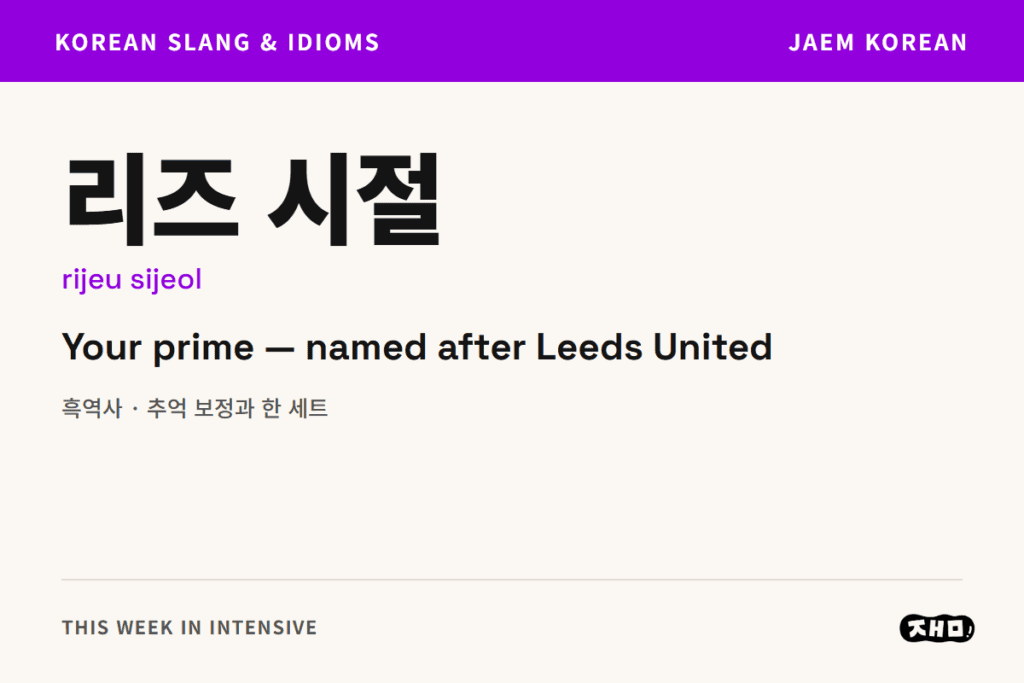
리즈 시절 (rijeu sijeol) means someone’s peak — the stretch of years when they looked or performed at their absolute best. Its opposite number in Korean conversation is 흑역사 (heukyeoksa), “dark history,” the embarrassing past you’d rather nobody scrolled back to. Koreans reach for the two words in the same breath, usually while an old photo is on the table.
That’s how you’ll first meet them. A friend pulls up a graduation picture, everyone laughs, and someone says “완전 흑역사네.” Then a better photo appears and the same friend sighs, “이때가 리즈 시절이었지.” Both sentences use grammar you already know and vocabulary your dictionary app doesn’t have.
What 리즈 시절 means, and why it involves an English football club
리즈 시절 splits into 리즈 + 시절. 시절 is ordinary Korean for a period or season of life — 학창 시절 is your school days. 리즈 is not Korean at all. It’s Leeds, the English city, from Leeds United.
The story goes back to Korean football forums in the 2000s. A player whose form at Leeds United was the high point of his career declined sharply after leaving, and fans started referring to that stretch as his “Leeds period.” The joke spread past football, past sports, and into ordinary speech, where it now applies to anybody’s prime: an idol’s best album, a colleague’s fittest year, your own face at twenty-two. Most Koreans who say it every week have no idea a football club is involved, so treat the origin as a fun fact rather than something you explain mid-conversation.
The word behaves like a plain noun.
이때가 제 리즈 시절이었어요. — This was my prime.
저 배우는 지금이 리즈 시절인 것 같아요. — I think that actor is in his prime right now.
리즈 시절 사진 좀 보여 주세요. — Show me a photo from your peak years.
You’ll also hear the clipped form 리즈, as in 리즈 때는 진짜 인기 많았어요 — back in his prime he was genuinely popular.
흑역사: the dark history you want deleted
흑역사 is literally “black history,” but the English words are a false friend — it has nothing to do with any nation’s past. It means an embarrassing chapter of your own: the middle-school haircut, the poems you posted online, the band you were in for four months. The word came out of anime and gaming communities and moved into everyday speech so completely that a grandmother can say it now.
그 사진은 제 흑역사예요. — That photo is my dark past.
중학교 때가 제일 큰 흑역사예요. — Middle school is my biggest embarrassment.
흑역사를 지우고 싶어요. — I want to erase my cringe past.
It’s a noun, so it takes 이다 endings: 흑역사예요, never 흑역사해요.
추억 보정: the filter between the two
Between your 흑역사 and your 리즈 시절 sits 추억 보정. 추억 is a fond memory; 보정 is the word used for retouching photos. Together it’s the nostalgia filter — remembering the past as better than it actually was. It’s what you say when someone insists their old job, old school, or old relationship was perfect.
그건 추억 보정이야. — That’s just the nostalgia filter.
추억 보정이 좀 심한 것 같아요. — I think your memory is doing some heavy retouching.
Two mini dialogues
Dialogue 1 — The old photo
민지: 이거 봐. 네 고등학교 졸업사진. — Look at this. Your high school graduation photo.
태호: 아, 그거 내 흑역사야. 지워 줘. — Ugh, that’s my dark past. Delete it.
민지: 왜? 귀여운데. 이때가 네 리즈 시절 아니야? — Why? It’s cute. Wasn’t this your peak?
태호: 리즈 시절은 대학교 2학년 때였지. 그땐 진짜 잘생겼었거든. — My peak was sophomore year. I was genuinely good-looking back then.
Dialogue 2 — The old job
수진: 예전 회사가 진짜 좋았어. 사람들도 좋고 일도 재미있었고. — My old company was really great. Good people, fun work.
현우: 근데 그때 맨날 야근했다고 울었잖아. — But you cried about working late every day back then.
수진: 그랬나? 지금 생각하면 다 좋았는데. — Did I? Looking back, it all seems good.
현우: 그게 추억 보정이야. 힘든 건 잊고 좋은 것만 남는 거. — That’s the nostalgia filter. You forget the hard parts and keep the good ones.
Similar and opposite expressions
전성기 — the standard, non-slang word for a peak or prime. A newspaper writes 전성기; a friend says 리즈 시절. Both work for athletes, singers, and ordinary people.
한물가다 — “to be past one’s prime,” the plain opposite of 리즈 시절. 그 노래 이제 한물갔어. — That song is over now.
이불킥 — literally “blanket kick,” the moment you remember your 흑역사 in bed and kick the covers. If 흑역사 is the event, 이불킥 is the reaction.
새록새록 — an adverb for memories surfacing vividly, one after another. 옛날 사진을 보니까 흑역사가 새록새록 떠올라요. — Looking at old photos, the embarrassing memories come flooding back.
전설 — “legend,” used jokingly about a moment everyone still remembers. It overlaps with 흑역사 when the moment was memorable for the wrong reasons.
When not to use these words
All three are casual, spoken vocabulary. Keep them out of essays, cover letters, and business email — write 전성기 for peak years and describe an awkward past in plain language.
Don’t call someone else’s real pain a 흑역사. The word is for cringe, not trauma. A bad haircut, an awkward confession, a failed audition are all fine; a divorce or a genuine loss is not. Koreans use the word lightly, which is exactly why it lands badly on heavy topics.
Be careful with 리즈 시절 about a person who is standing there. Saying “이때가 리즈 시절이었네” over a friend’s old photo implies they’ve gone downhill since. Among close friends that’s the joke. To a coworker or someone older, it stings. Safest: use it about yourself, or about celebrities.
How we practice this in Intensive
리즈 시절 and 흑역사 come from the Wednesday expression pages of April Week A, and 추억 보정 from January Week B. The weekly PDF gives each expression a short definition, then moves straight into a dialogue built around a story — in this case a first love and a rainy day. You read it, you listen to it, and the quiz asks you to retell part of it in your own words.
The Wednesday mission asks you to talk about your own 흑역사 or 리즈 시절, which is the fastest way to find out whether you can use the word or only recognize it. In the recorded group class, students share theirs and the teacher corrects the sentence around the word as much as the word itself. Your weekly 30-minute 1:1 is where the story gets polished until it sounds like something you’d say to a Korean friend rather than something you read.
자주 묻는 질문
What does 리즈 시절 mean in Korean?
리즈 시절 means someone’s peak or golden era — the period when they looked or performed their best. 리즈 is Leeds, from the English football club Leeds United, and 시절 means a period of life. It’s casual and used about yourself, friends, or celebrities.
Is 흑역사 a rude word?
No. It’s playful and self-deprecating, and people use it about themselves constantly. The only risk is applying it to something that was genuinely painful for someone else. Keep it for cringe.
Do Koreans know 리즈 시절 comes from Leeds United?
Most don’t, and it doesn’t matter. The phrase has fully detached from its origin. Knowing the story is a fun fact to share, not something you need to explain when you use it.
Where to go from here
The grammar half of this week is -거든요 vs -잖아요, the two endings you’ll need the moment you start explaining why that haircut happened.
Knowing what 리즈 시절 means takes thirty seconds. Telling a story about yours, in Korean, out loud, while someone laughs and asks follow-up questions, is what Intensive Challenge trains. Six weeks, a weekly PDF with daily missions, recorded group classes, and a 30-minute 1:1 every week where your sentences get corrected as you say them. In six weeks, the words come out. And you feel confident using them.
If you’d like to hear a class before deciding, start with a free lecture.
Know the grammar, but can’t say it yet?
문법은 아는데 말이 안 나와요?
There is a program for each level and goal. Tell us your level and we’ll point you to one.

About the author
크리스
Chris has taught Korean in Korea for over four years. He teaches TOPIK prep, business Korean, and intermediate to advanced speaking. He is also the head teacher of JAEM.
One Korean tip a week
뉴스레터 · 매주 한 번
A short email with Korean you can use this week. In English, with Korean examples.