In this article
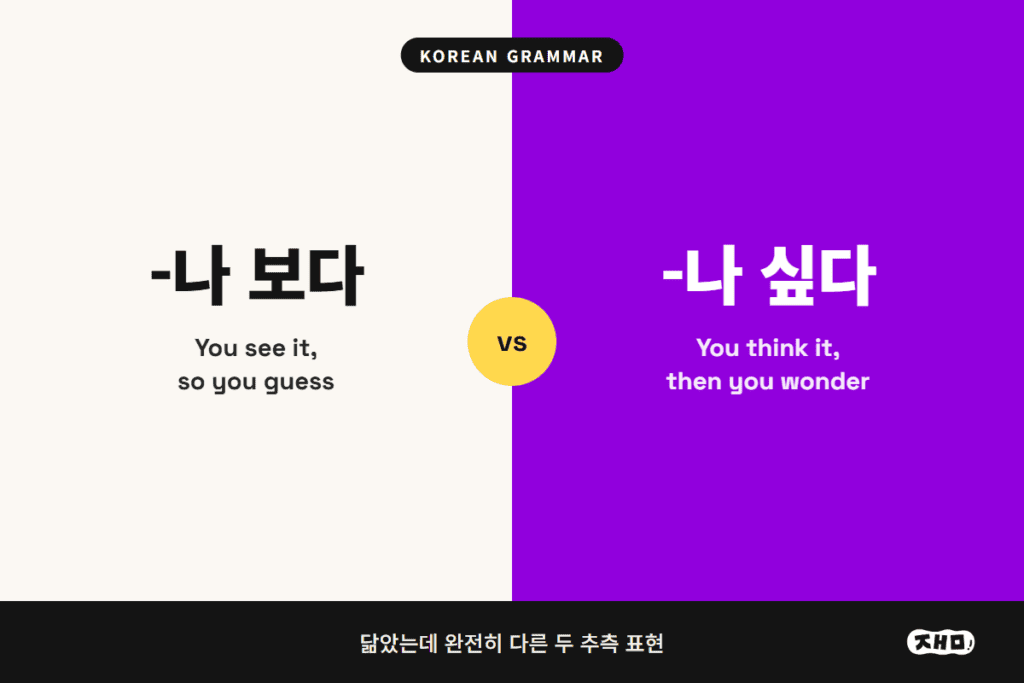
-나 보다 is the Korean ending you use when visible evidence leads you to a conclusion — “it seems,” “I guess,” judging by what is in front of you. It is a TOPIK II intermediate grammar point and by far the more common of the pair in this post. Its quieter partner, -나 싶다, is the guess that stays inside your head: “I wonder if…,” “I’m thinking maybe….” Same English translations, two different sources of the guess, and that is the whole difference.
Picture both. A friend keeps yawning, so you say out loud that she must be tired — that is -나 보다. Later you lie awake wondering whether you said something wrong at dinner — that is -나 싶다. This post separates them, adds the third ending from the same week, -(으)ㄹ걸요, and gives you nine sentences to test yourself on.
What -나 보다 means
-나 보다 attaches to a verb stem (먹나 보다, 가나 보다) and reports a conclusion you have just drawn from something you can see, hear, or notice. It is fast, spoken, and almost always about someone or something other than yourself.
Adjectives take -(으)ㄴ가 instead: 큰가 보다, 비싼가 보다. Past tense goes inside the ending: 갔나 보다, 왔나 보다. In writing you will also meet the slightly more formal -는가 보다.
Wet pavement, a long line outside a restaurant, all the office lights off — you see the clue and you say the conclusion out loud. That is the entire job of -나 보다.
Koreans rarely use it about their own inner state, because you do not need visible evidence to know how you feel. That restriction is the source of the first mistake below.
What -나 싶다 means
-나 싶다 turns the same kind of statement into a thought rather than an announcement: “I wonder if…,” “I’m thinking maybe….” The guess happens inside your head, it is tentative, and it is often a little worried.
It shows up when someone is turning a thought over. Did I lock the door? Was that email too blunt? Is this the right job for me? There may be no evidence at all — just a nagging feeling. That is why it pairs so naturally with worry, regret, and second-guessing.
Unlike -나 보다, it works perfectly well about yourself: 내가 너무 예민한가 싶어요 — “I wonder if I’m being too sensitive.”
The classroom line we give students is four words long: 보다 is seeing, 싶다 is thinking.
-나 보다 vs -나 싶다 vs -(으)ㄹ걸요
Here is the three-way split we draw on the board in group class:
| Ending | Where the guess comes from | Feel |
|---|---|---|
| -나 보다 | visible evidence | quick, “it seems” |
| -나 싶다 | inside your head | tentative, “I wonder” |
| -(으)ㄹ걸요 | your own opinion, said softly | mild disagreement, “I’d say…” |
-(으)ㄹ걸요 is the odd one out. It is not really a guess from evidence; it is a way of offering a different opinion without sounding pushy. If someone says the café is open now, 아직 안 열었을걸요? means “I’d say it isn’t open yet, actually.” The rising tone at the end is what keeps it polite.
A quick test. If you can add “because I can see that…,” you want -나 보다. If you can add “I keep wondering…,” you want -나 싶다. If you are gently correcting someone, -(으)ㄹ걸요.
Plenty of sites and Q&A threads compare this pair already; what we’ve tried to add is sentence density and the specific slips that come up in class.
Nine example sentences
불이 다 꺼져 있네요. 다들 퇴근했나 봐요. — The lights are all off. I guess everyone has left work.
줄이 저렇게 긴 걸 보니까 맛집인가 봐요. — Seeing a line that long, it must be a popular place.
아이가 계속 냉장고를 여는 걸 보니 배고픈가 봐요. — The kid keeps opening the fridge, so he must be hungry.
길이 젖어 있네요. 밤에 비가 왔나 봐요. — The road is wet. It must have rained overnight.
답장이 늦어서 내가 뭘 잘못 말했나 싶었어요. — The reply was slow, so I wondered if I’d said something wrong.
요즘 계속 피곤해서 운동을 너무 많이 하나 싶어요. — I’ve been tired lately, so I’m thinking maybe I’m exercising too much.
이 회사가 나한테 맞는 곳인가 싶어서 요즘 고민이 많아요. — I’ve been wondering whether this company is the right fit for me.
주말이라 길이 막힐걸요? 지하철로 가요. — I’d say the roads will be jammed since it’s the weekend. Let’s take the subway.
그 영화는 이미 상영 끝났을걸요? — I’m fairly sure that movie is no longer showing.
Common mistakes
Mistake 1: using -나 보다 about your own feelings. Students say 저는 피곤하나 봐요 when they mean “I think I’m tired.” Koreans hear this as strange, because you do not observe your own tiredness from the outside. Say 저 좀 피곤한가 싶어요, or simply 피곤해요.
Mistake 2: attaching -나 directly to an adjective. 비싸나 봐요 is a very common slip. Adjectives take -(으)ㄴ가: 비싼가 봐요, 비싼가 싶어요. Verbs take -나: 사나 봐요. 있다 and 없다 behave like verbs here — 있나 봐요, 없나 싶어요.
Mistake 3: flattening the intonation on -(으)ㄹ걸요. Said flat, 늦을걸요 can sound like you are brushing the other person off. Let the pitch rise at the end and it turns back into a soft, friendly “I’d say.”
How we practice this in Intensive
This trio comes from the Week A material of our Интенсивный вызов, the week built around describing someone’s personality and guessing what they are really like. The weekly PDF introduces the three endings together with a short contrast explanation, then drills them through patterns rather than isolated sentences: an observation opener like -던데 followed by a guess, a -(으)니까 reason followed by a guess, and so on. That structure is what makes the difference stick, because you practice choosing the ending based on where the guess came from.
Each student writes three sentences for the day’s mission and brings them to the recorded group class, where we read them aloud and fix the ones that picked the wrong ending. Then in the weekly 30-minute 1:1 the teacher pushes further: “you said -나 봐요 — what did you see?” If the answer is “nothing, I just thought so,” we switch it to -나 싶어요 on the spot. That week’s 1:1 dialogue cards are all guessing scenarios, so you make the same choice ten or twelve times in one session.
Часто задаваемые вопросы
What is the difference between -나 보다 and -나 싶다 in Korean?
-나 보다 draws a conclusion from something you can see or hear right now, and is usually about other people. -나 싶다 is a guess or worry that forms inside your own head, with or without evidence, and works fine about yourself.
Can I use -나 보다 in the past tense?
Yes. Put the past marker before -나: 비가 왔나 봐요 (“it must have rained”). The same works for -나 싶다: 늦게 잤나 싶었어요. The 보다/싶다 part usually matches the tense of the sentence around it.
Is -나 싶다 the same as -고 싶다?
No. -고 싶다 means “want to” (먹고 싶다, want to eat). -나 싶다 is a guess or a passing thought (먹나 싶다, “I wonder if they’re eating”). The 싶다 is the same word, but the connector changes the meaning completely.
Where to go from here
Guessing endings are the kind of grammar you can understand in five minutes and still misuse for a year, because the choice depends on something invisible in the sentence: where your guess came from. The fix is practice with correction, not more explanation.
In six weeks, the words come out. And you feel confident using them — see how the program works at jaem.io/programs/intensive-challenge. Thursday’s post covers the expression half of the same week, 실화냐 and the language of half-believing something, which is exactly the mood -나 보다 lives in. If you want to see how we teach before joining, the free lecture is the place to start.
Know the grammar, but can’t say it yet?
문법은 아는데 말이 안 나와요?
There is a program for each level and goal. Tell us your level and we’ll point you to one.

About the author
Крис
Chris has taught Korean in Korea for over four years. He teaches TOPIK prep, business Korean, and intermediate to advanced speaking. He is also the head teacher of JAEM.
One Korean tip a week
뉴스레터 · 매주 한 번
A short email with Korean you can use this week. In English, with Korean examples.