In this article
You know the passages. You know most of the grammar. And you still run out of time before question 50. If that sounds familiar, the problem usually isn’t comprehension — it’s that TOPIK II reading gives you 50 questions in 70 minutes, and treating every question the same way is what eats your clock.
We see this pattern in almost every new student: strong readers who score lower than their actual Korean ability because they spent four minutes perfecting an easy question in the first third of the test and then had to rush the hardest ones at the end. Fixing that isn’t about reading faster in general — it’s about knowing which questions deserve 30 seconds and which ones deserve two minutes.
Why TOPIK II Reading Feels Like a Time Trap
Fifty questions, 70 minutes, 100 points — that averages out to about 84 seconds per question, but the exam isn’t designed to be even. The early questions are short and mechanical; the later ones require reading a full passage, holding it in your head, and comparing it against four answer options that are all plausible on a surface read. Students who pace evenly across all 50 run out of runway exactly where the questions need the most time.
The other hidden cause is translation habit. If you’re mentally converting Korean into your first language sentence by sentence, you’re doing double the reading work in the same 70 minutes. That habit is invisible until you’re timed, which is why it tends to surface for the first time during a full practice test rather than in regular study.
The 10 Question Types, Grouped by Difficulty
These aren’t official NIIED category names — they’re how we group and label them for teaching, based on what each block of questions is actually asking you to do. Numbering below reflects a typical exam layout; exact ranges can shift slightly between rounds.
Early block (roughly 1–12) — fast, mechanical:
- Grammar/particle fill-in — choosing the correct connector or particle in a short sentence
- Vocabulary-in-context — picking the word that fits a short blank
- Short notice comprehension — reading a sign, label, or short notice and matching meaning
Middle block (roughly 13–34) — structure and inference:
- Sentence ordering — arranging three or four sentences into logical sequence
- Fill-in-the-blank (longer passage) — same skill as writing 51/52, but multiple choice
- Matching graphic/chart to text — reading a short passage alongside a simple graphic
- Purpose/main idea of a short passage
- Correct-inference from a short passage (what can/can’t be concluded)
Late block (roughly 35–50) — highest difficulty:
- Author’s attitude or tone — inferring stance, not just fact
- Sentence insertion and detailed comprehension — placing a missing sentence correctly in a longer passage, or answering detail questions that require holding the whole passage in mind
The pattern across all ten: earlier types test whether you understood the words; later types test whether you understood the argument.
A Realistic Time Budget: Minute-by-Minute
We coach a rough three-block budget rather than 50 even splits:
- Questions 1–18 (roughly 15 minutes): move quickly. These are short and mechanical enough that if you’re spending more than a minute on any single one, you’re probably overthinking a question that doesn’t need it.
- Questions 19–41 (roughly 25 minutes): this is where sentence ordering, inference, and longer fill-in-the-blank questions live. Budget close to a minute and a half each here, and allow yourself to actually read the full passage once before jumping to the options.
- Questions 42–50 (roughly 30 minutes): the final block is short in question count but heavy in reading load. These deserve close to two minutes each, including the time to reread a key sentence if the options are close.
That leaves a small buffer, which matters more than it sounds — a buffer is what lets you go back to a question you flagged instead of guessing blind because time ran out.
The Skip-and-Return Rule (and When to Break It)
If a question in the early or middle block is taking noticeably longer than its budget, mark your best guess, flag it, and move on. Coming back with three minutes left at the end is almost always better than losing five minutes mid-test on one question while the clock keeps running on everything after it.
The exception is the late block. By the time you’re in questions 42–50, there’s rarely time left to “come back” — so within that block, work in order and commit to the pacing rather than skipping around, since skipping there tends to cost more time than it saves.
Question Types Worth Extra Practice Time
Not all ten types improve at the same rate with practice. Sentence ordering and author’s-attitude questions are the two we spend the most drilling time on with students, because they’re skill-based rather than vocabulary-based — you get faster at spotting logical connectors and tone markers with repetition in a way that plain vocabulary review doesn’t replicate.
By contrast, the short notice and vocabulary-in-context questions in the early block usually improve on their own as general reading volume increases, so they’re a lower priority for dedicated drilling time once you’re past a beginner level.
Where to go from here
A time budget only helps once your reading speed can actually hit it — and that’s less about memorizing more words and more about breaking the habit of translating full sentences before you understand them.
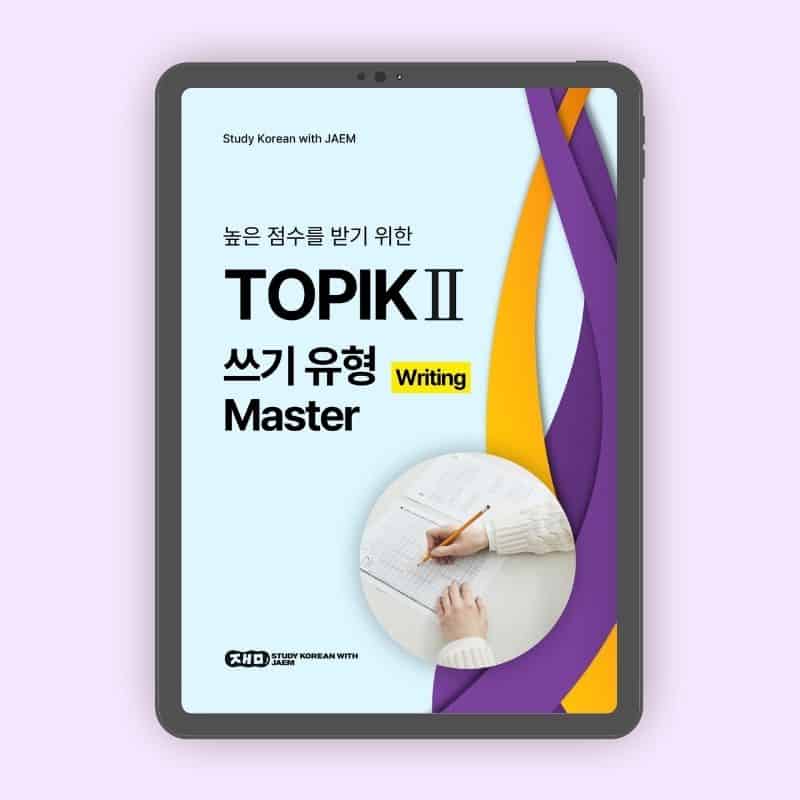
In TOPIK 2 Master, reading isn’t taught as another vocabulary list — it’s taught as question types and managing the clock, which is the actual skill this section tests. We set a target level first, so the pacing and question focus match whether you’re aiming for a 4, a 5, or a 6, and writing (where scores tend to move fastest) gets direct one-on-one teacher feedback across the six weeks.
Check current dates and details on the TOPIK 2 Master program page, or start with a free lecture to see the teaching style before enrolling.
If you want the diagnostic side of this — why your score might be low in the first place rather than how to pace it — our earlier post on why your TOPIK reading score is low covers that angle in more depth.
FAQ
How many questions are in the TOPIK II reading section and how long do I have?
50 questions in 70 minutes, worth 100 points total.
What should I do if I’m running out of time?
Mark your best guess on the question that’s taking too long, flag it if you can, and move on — recovering three unanswered questions at the end is usually worth more than perfecting one mid-test question. In the final block (roughly 42–50), work in order rather than skipping, since there’s rarely time left to circle back that late.
Which reading question types are the hardest to improve?
Author’s-attitude and tone questions, along with sentence-insertion questions in the late block, tend to take the longest to improve because they require inference rather than direct comprehension. We spend extra drilling time on exactly these two types with students.
Start TOPIK II prep with our free pack.
One email. Instant access to our most-downloaded PDFs: TOPIK I basics, TOPIK II words, and the 2027 test dates.

About the author
Chris
Chris has taught Korean in Korea for over four years. He teaches TOPIK prep, business Korean, and intermediate to advanced speaking. He is also the head teacher of JAEM.
One Korean tip a week
뉴스레터 · 매주 한 번
A short email with Korean you can use this week. In English, with Korean examples.