In this article
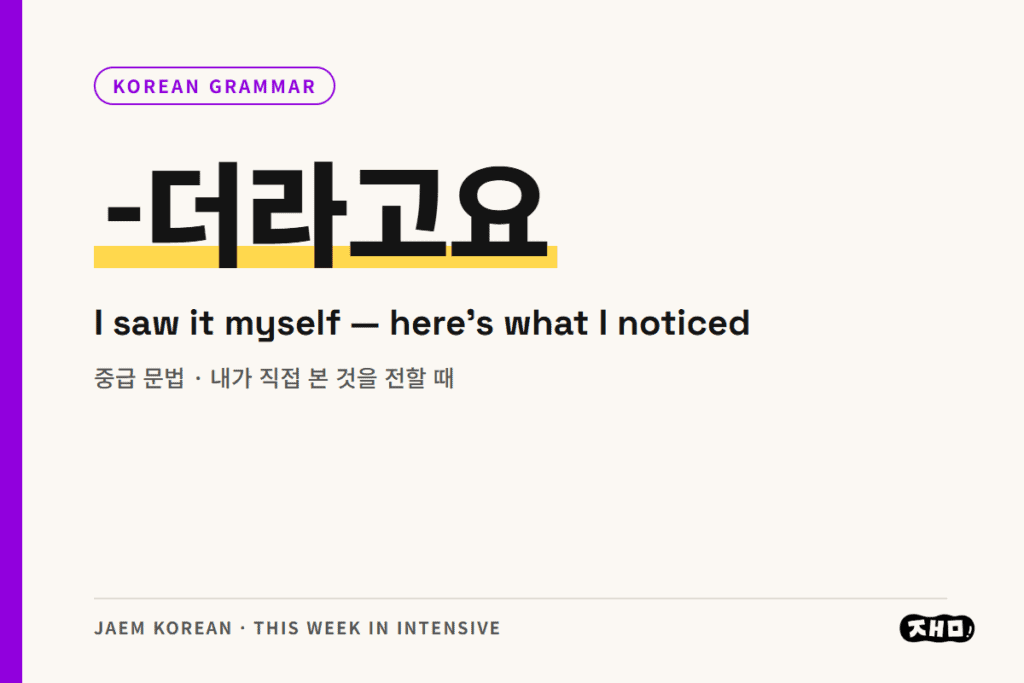
-더라고요 is the Korean sentence ending you use to report something you personally witnessed — “I saw it, and here’s what I found.” It attaches straight to a verb, adjective, or noun stem and tells the listener two things at once: this is information, and I got it firsthand. It is a TOPIK II intermediate grammar point, and it is one of the highest-frequency pieces of spoken Korean that textbooks leave until far too late. This post covers what -더라고요 does, how it differs from plain past tense and from -던데요, and the mistakes that make learners sound like they are narrating themselves from across the room.
What -더라고요 means
The 더 in the middle is a retrospective marker: it says “I was there, I observed this.” The 고요 wraps the observation in a soft, conversational tone, as if you are handing over what you found.
It attaches directly to stems with no tense change: 비싸다 → 비싸더라고요, 많다 → 많더라고요, 오다 → 오더라고요. With nouns it takes (이): 학생이더라고요, 가수더라고요.
Two flavors ride along with the basic meaning. First, discovery — the thing you saw was new information to you at the moment you saw it. Second, mild surprise, especially when what you saw did not match what you expected. That is why 생각보다 (“compared to what I thought”) turns up next to -더라고요 so often.
When Koreans actually use -더라고요
Imagine you went to the ramen place everyone was talking about. It was fine, not great, and the line was forty minutes. A friend asks how it was. The natural Korean answer is 생각보다 별로더라고요 — not a plain past tense, because you are not just stating a fact, you are reporting an experience.
Outside of reviews, -더라고요 does three everyday jobs.
Softening a correction. 그 서류는 3층에서 받더라고요 (“I found out you get that form on the third floor”) is gentler than 3층이에요, because it frames the information as something you happened to discover rather than something the other person should have known.
Explaining a changed plan. 가 보니까 문을 닫았더라고요 (“when I got there, it was closed”) is the standard opener for “so I went somewhere else.”
Reporting a pattern you noticed. Anything you observed repeatedly about people, places, or habits.
The one thing -더라고요 never does is describe your own deliberate actions from the inside. That restriction drives the most common mistake below.
-더라고요 vs -았/었어요 and -던데요
-았/었어요 reports a past fact with no comment on how you know it. 비쌌어요 could be something you read online. 비싸더라고요 means you looked at the menu yourself. If your listener answers a plain past-tense sentence with 직접 가 봤어요? (“did you go yourself?”), that is a sign -더라고요 would have answered the question before it was asked.
-던데요 is the closest cousin. Both are retrospective; the difference is what happens after the sentence.
- -던데요 leaves the door open. It expects a reaction, a follow-up, sometimes a disagreement. 사람이 많던데요 is “there were a lot of people — so, what do you think?”
- -더라고요 closes the sentence. 사람이 많더라고요 is “there were a lot of people; that is my report.”
A quick way to feel it: -던데요 tends to rise at the end and leave a pause. -더라고요 falls and stops. When you are handing someone a decision, use -던데요. When you are telling a story, use -더라고요.
Nine -더라고요 example sentences
그 강의 들어 봤는데 설명이 정말 쉽더라고요. — I tried that lecture, and the explanations were really easy to follow.
주말에 한강 갔는데 자전거 빌리는 데가 없어졌더라고요. — I went to the Han River on the weekend, and the bike rental place was gone.
동생이 요즘 요리하더라고요. 저보다 잘해요. — My younger sibling has been cooking lately, I noticed. Better than me.
회의실 예약이 벌써 꽉 찼더라고요. 그래서 카페에서 했어요. — The meeting rooms were already fully booked, so we did it at a café.
‘설마 눈이 오겠어?’ 했는데 아침에 나가 보니까 쌓였더라고요. — I thought “no way it’ll snow,” but when I went out in the morning it had piled up.
한국 친구들은 밥 먹고 꼭 카페에 가더라고요. — Korean friends always go to a café after a meal, I’ve found.
그 영화 보니까 눈물이 나더라고요. — Watching that movie, I found tears coming.
이사 온 집이 생각보다 조용하더라고요. — The place I moved into is quieter than I expected.
약국에 갔는데 그 약은 처방전이 있어야 되더라고요. — I went to the pharmacy, and it turns out you need a prescription for that medicine.
Two of these use 았/었 before 더라고요. That is not a past tense of the observation — it means the state had already happened when you arrived: the shop was already gone, the rooms were already booked. Without 었, 없어지더라고요 would mean you stood there and watched it disappear.
Common mistakes with -더라고요
Mistake 1: using it about your own choices. 저는 어제 열심히 공부하더라고요 sounds like you watched yourself from across the room. -더라고요 observes others and the world, not your own decisions. The exception is feelings and physical states that happen to you: 눈물이 나더라고요 and 갑자기 배가 아프더라고요 are perfect, because neither was a decision.
Mistake 2: using it for things you did not witness. If a friend told you the café was crowded, that is 많대요 (“I hear it’s crowded”), not 많더라고요. One of our students used -더라고요 to retell a news story, and her language partner asked, confused, whether she had been at the scene. The ending makes a claim of presence — keep it honest.
Mistake 3: doubling the 요. Nervous learners sometimes produce 더라고요요. The 요 is already in there. Stop after 고요.
How we practice -더라고요 in Intensive
-더라고요 is the Tuesday grammar point of the Week B material in our Intensive Challenge, the week titled “설마 했는데 진짜로.” The PDF introduces -더라고요 first, then 설마 -겠어요?, then combines the two in a drill where you quote your own doubt and finish with what actually happened — every sentence turns into a small plot twist.
The pattern section also attaches -더라고요 to experience openers like -아/어 봤는데 and -(으)ㄴ 적이 있는데, which locks the “I witnessed it” meaning into the sentence frame itself. The Tuesday mission is three sentences from your own week, corrected in your 30-minute 1:1, and the group class is recorded so you can rewatch the falling intonation — half of what makes -더라고요 sound native.
FAQ
Is -더라고요 formal or informal Korean grammar?
It is polite but conversational. Use it with friends, coworkers, and teachers. In formal writing or presentations, switch to -았/었습니다 and state the fact plainly.
What is the casual form of -더라고요?
Drop the 요 for -더라고, or shorten it further to -더라: 생각보다 비싸더라. Both are common among friends.
Can I use -더라고요 with 있다 and 없다?
Yes. 없더라고요 (“there wasn’t any, I found”) and 있더라고요 (“there was”) are among the most common uses, especially when you went looking for something.
Where to go from here
The hard part of -더라고요 is not the form. It is trusting yourself to use it in the moment, with the right falling intonation and without the doubled 요. That only comes from saying it to a person who answers back.
In six weeks, the words come out. And you feel confident using them. See how the program works at jaem.io/programs/intensive-challenge. Thursday’s post covers the drama slang from the same week — 정주행, 스포, and 떡밥 — which is a good place to practice this ending, since every review of a show is a sentence waiting for -더라고요. If you’d like to hear a teacher first, our free lecture is the easiest starting point.
Know the grammar, but can’t say it yet?
문법은 아는데 말이 안 나와요?
There is a program for each level and goal. Tell us your level and we’ll point you to one.

About the author
Chris
Chris has taught Korean in Korea for over four years. He teaches TOPIK prep, business Korean, and intermediate to advanced speaking. He is also the head teacher of JAEM.
One Korean tip a week
뉴스레터 · 매주 한 번
A short email with Korean you can use this week. In English, with Korean examples.