In this article
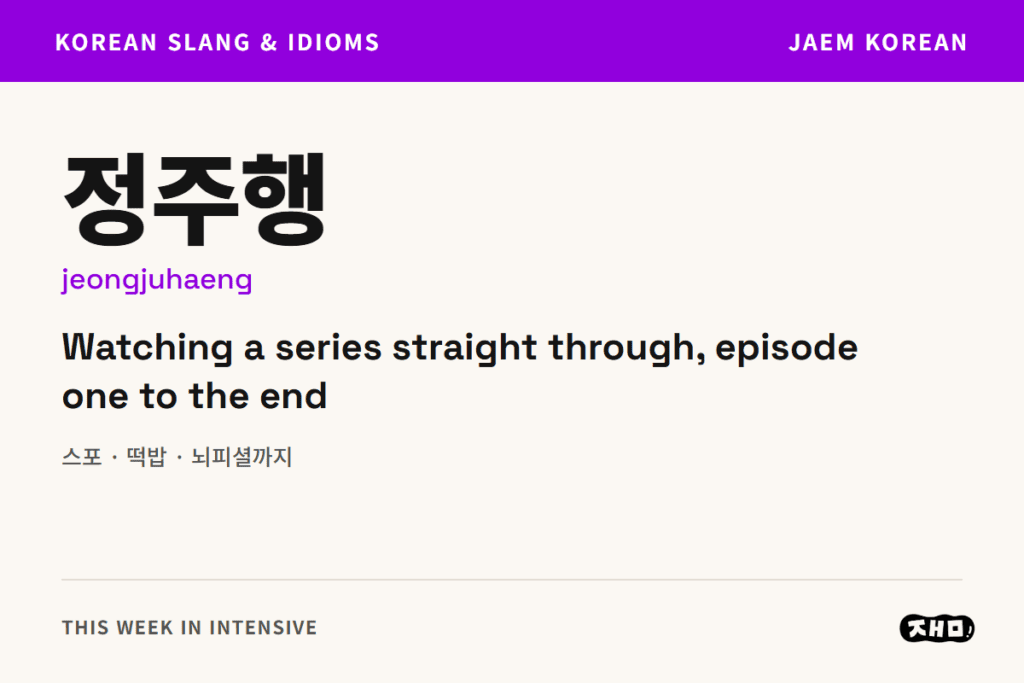
정주행 means watching a series straight through from the first episode to the last, in order — Korean for binge-watching. It comes from 정 (正, forward, correct) and 주행 (driving), the image of a car going straight down the road with no detours. Around it sit three more fandom words you’ll meet in every comment section: 스포, 떡밥, and 뇌피셜.
A new season lands on Friday and your Korean friend messages: 시즌 1 정주행했어? 스포 조심해, 댓글마다 떡밥 얘기야. If you caught maybe one word of that, this is the vocabulary you’re missing.
What 정주행 means and where it comes from
The 주행 half is the ordinary word for a vehicle in motion, and 정 marks the forward, proper direction. Watching in order, one episode after another, is driving straight. Its mirror image, 역주행 — “driving the wrong way” — has its own slang life: a song or show that climbs the charts long after release, going backward up the timeline.
Use it as a verb with 하다.
주말에 그 드라마 정주행했어요. — I binged that drama over the weekend.
열두 편을 이틀 만에 정주행했어요. — I watched all twelve episodes in two days.
정주행하기 전에 리뷰는 안 봐요. — I don’t read reviews before binging a show.
그 가수 옛날 노래가 요즘 역주행하고 있어요. — That singer’s old song is climbing the charts again.
스포, 떡밥, 뇌피셜: the words that come with it
스포
A clipping of 스포일러 (spoiler). Korean shortens loanwords aggressively, and 스포 is the survivor. It works as a noun (스포 주의, spoiler warning) and as a verb with 하다. Someone who does it is a 스포러; getting spoiled against your will is 스포 당하다.
아직 4화예요. 절대 스포하지 마세요. — I’m only on episode four. Please don’t spoil it.
어제 댓글 보다가 스포 당했어요. — I got spoiled reading comments yesterday.
떡밥
The most Korean of the four. Literally fishing bait — the doughy kind made from 떡 (rice cake) and 밥 (feed) and pressed onto a hook. In drama talk it means a clue or piece of foreshadowing the writers planted so it can pay off later: an odd object in episode one, a line that makes no sense until episode twelve. When the payoff arrives, fans say 떡밥 회수 (the bait was collected). When a show ends without explaining a clue, that’s 떡밥 방치 — bait left lying around — one of the harshest things a fandom can say about a finale.
2화에 나온 그 사진, 그거 떡밥이에요. — That photo in episode two is a planted clue.
마지막 회에서 떡밥이 다 회수됐어요. — All the clues paid off in the final episode.
뇌피셜
뇌 (brain) + 오피셜 (official): a theory that is official only inside your own head. Fans use it about themselves, half-apologetically, to flag a guess. Turned on someone else it becomes a jab.
내 뇌피셜인데, 형이 범인이야. — Just my theory, but the older brother is the culprit.
그건 네 뇌피셜이지, 근거가 없잖아. — That’s just your theory; there’s no evidence.
Two mini dialogues
Two coworkers on Monday morning:
A: 주말에 뭐 했어요? — What did you do this weekend?
B: 그 법정 드라마 정주행했어요. 열두 편을 이틀 만에 봤어요. — I binged that legal drama. Twelve episodes in two days.
A: 저 아직 4화예요. 절대 스포하지 마세요. — I’m still on episode four. Do not spoil it.
B: 안 해요. 근데 2화에 나온 그 사진, 잘 봐 두세요. — I won’t. But keep an eye on that photo from episode two.
A: 그 말 자체가 스포 아니에요? — Isn’t that itself a spoiler?
Two friends in a group chat, the night before a finale:
A: 내 뇌피셜인데, 형이 범인이야. — Just my theory, but the older brother is the killer.
B: 근거는? — Based on what?
A: 1화에서 손목시계 찬 손이 왼손이었어. 형만 왼손잡이잖아. — In episode one the hand wearing the watch was the left one. Only he is left-handed.
B: 오, 그건 뇌피셜치고 꽤 그럴듯한데? — Oh, for a brain-theory that’s pretty convincing.
A: 내일 떡밥 회수되면 커피 사. — If the clue pays off tomorrow, you’re buying coffee.
Similar and opposite expressions
- 몰아보다 — the plain-Korean equivalent of 정주행하다, “to watch all at once.” Less fan-flavored; you can 몰아보다 something you’re only mildly interested in, while 정주행 implies commitment.
- 본방 사수 — the opposite behavior: watching the live broadcast (본방) and defending (사수) that time slot against all other plans.
- 복선 — the formal, literary word for foreshadowing. A critic says 복선; a fan says 떡밥.
- 반전 — the twist itself, the moment the bait is collected.
- 팩트 — fact, the everyday opposite of 뇌피셜. Koreans put them in one sentence: 뇌피셜 말고 팩트만.
- 노스포 or 스포 없음 — marks a review as spoiler-free, the phrase to look for before reading any Korean post about a show you haven’t finished.
When not to use these words
Don’t use 정주행 for a single film. It needs a sequence. 영화 정주행 works only if you mean a whole franchise.
Don’t use 스포 in formal writing. In a report or paper the word is 스포일러 in full, or better, 결말 공개. 스포 is chat-level language.
Be careful with 떡밥 outside drama talk. In broader internet slang it also means clickbait or a topic thrown out to start an argument — 떡밥 던지지 마, don’t throw bait. The Intensive material deliberately teaches only the drama meaning, the planted clue, because that’s the safe one. Aimed at a person’s post, 떡밥 can read as calling them a troll.
Don’t call your boss’s idea 뇌피셜. About your own guess it’s modest; about someone else’s it’s dismissive. One of our students tried it on a coworker’s forecast and learned this the hard way.
How we practice this in Intensive
These four expressions come from 8월 Week B of the Intensive Challenge, themed “설명하고 정의하기” — explaining and defining. That’s why the week’s grammar is N이/가 뭐냐면 and -다는 건/게, the patterns for saying “what X is, is…” The expressions give you a reason to use them: explaining what 떡밥 means to a friend who has never heard it is the whole exercise.
Wednesday’s format is the four expressions with short dialogues, a longer main dialogue between two fans arguing about a season finale, a comprehension quiz, and a mission where students introduce a scene from something they watched recently and guess what a show they want to watch next is about. The 30-minute 1:1 that week tends to become a review of whatever the student is currently bingeing, which is the point. Group classes are recorded, so the theories survive.
FAQ
What does 정주행 mean in Korean?
정주행 means binge-watching: viewing a series from the first episode to the last, in order, usually over a short stretch. Use it as a verb — 정주행하다 — for dramas, webtoons, novel series, and even a musician’s discography.
Is 정주행 only for TV shows?
No. Anything with a fixed order works. Koreans 정주행 webtoons, YouTube channels, and albums as readily as dramas.
What is the difference between 스포 and 스포일러?
Same meaning. 스포 is the shortened, casual form used in speech and chat; 스포일러 is the full loanword used in writing and by people who don’t use much slang.
Where to go from here
Slang like this is easy to understand and surprisingly hard to produce. The first time you say 그거 떡밥이에요 to a Korean friend and they nod instead of laughing, something shifts.
That moment is what the Intensive Challenge is designed to produce, on purpose, every week. In six weeks, the words come out. And you feel confident using them. Every sentence you write about your favorite show gets corrected before the habit sets.
For the grammar you need to review a show properly, read this week’s post on -더라고요, the ending Koreans use for “I watched it, and here’s what I found.” And if you’d like to see how we teach first, start with the free lecture.
Know the grammar, but can’t say it yet?
문법은 아는데 말이 안 나와요?
There is a program for each level and goal. Tell us your level and we’ll point you to one.

About the author
Chris
Chris has taught Korean in Korea for over four years. He teaches TOPIK prep, business Korean, and intermediate to advanced speaking. He is also the head teacher of JAEM.
One Korean tip a week
뉴스레터 · 매주 한 번
A short email with Korean you can use this week. In English, with Korean examples.